
![Types of Salamanders in Michigan [Backyard Guide]](https://reptilesinfo.com/wp-content/uploads/2026/06/Types-of-Salamanders-in-Michigan-Backyard-Guide.jpg)
Michigan is home to a wide range of wildlife, including snakes, turtles, lizards, and many interesting amphibians. Among these animals, salamanders in michigan are especially fascinating because they live in different Michigan habitats, such as forests, wetlands, ponds, streams, and damp woodland areas.
Many people know Michigan for its reptiles, but the state also has several beautiful and unique salamander species. In this guide, we will explore the 10 most common salamanders in Michigan, their natural ecosystems, and the places where they are usually found.
Blue-Spotted Salamander: A Small Amphibian with Bright Markings
The blue-spotted salamander is one of the most attractive and easily recognized salamander species found in North America. It is especially common in eastern regions, where it lives in moist forests, wetlands, woodlands, and other damp semi-aquatic habitats. These areas provide the amphibian with enough food, shelter, and safe places to hide.
This salamander usually has a dark blue, gray, or black body covered with small light-blue spots. In some individuals, the bright markings are so clear that they almost look like tiny stars across the skin. The blue-spotted salamander is small in size and usually grows up to about 5 inches long. It has short legs, a broad head, and large dark eyes that help it move and hunt at night.
Like many other carnivorous salamanders, this species feeds on insects, snails, worms, and other small invertebrates. It often hunts by staying still and waiting for prey to come close. When the prey is near, the salamander quickly uses its long, sticky tongue to catch and swallow it.
The blue-spotted salamander is mostly nocturnal, meaning it is more active at night. Although it is small, it can be territorial and may act defensively around other salamanders. It is not dangerous to humans, but it is still best to handle it gently and avoid disturbing its natural Michigan habitat.
Read Also Full-Grown Beardie Size [Male vs Female]Eastern Newt: A Colorful Salamander with a Unique Life Cycle
The eastern newt is one of the most unusual and eye-catching salamander species found in North America. It has smooth, shiny skin and a small body that may appear brown, olive, orange, or reddish, depending on its age and life stage. Many individuals also have small rounded spots along the sides, which make them easier to recognize in the wild.
This small amphibian usually grows up to about 5 inches long. It has a rounded head, large eyes, and soft toes that give it a delicate appearance. The eastern newt is considered a semi-aquatic salamander because it spends part of its life in water and part of its life on land.
In Michigan habitats, eastern newts are commonly found near ponds, marshes, wetlands, clear streams, and damp forest areas. They may be seen resting on rocks, moving near the shoreline, or hiding under leaves and logs. Like many other nocturnal amphibians, they are skilled hunters, but they often use a patient hunting style by waiting for small prey to come close.
The eastern newt is a carnivorous amphibian that mainly eats insects, worms, snails, and other small invertebrates. It catches prey quickly with its sticky tongue and can eat more than people might expect for its small size.
Eastern Tiger Salamander: A Large Spotted Amphibian
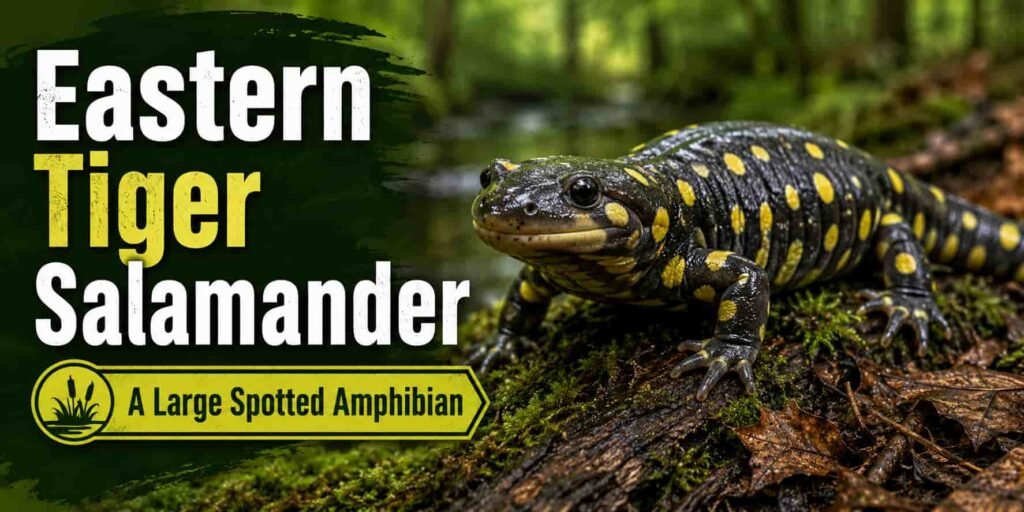
The eastern tiger salamander is one of the largest and most recognizable salamander species found in North America. Its bold body markings often look like tiger-like stripes or blotches, which is where its name comes from. This amphibian usually has a strong body, a broad head, small eyes, and a dark body covered with yellow or olive markings.
In the wild, the eastern tiger salamander can grow around 7 to 8 inches long. It is mostly found in damp Michigan habitats, especially near swamps, marshes, wetlands, ponds, and slow-moving streams. These moist areas help the salamander find food, stay hidden, and complete its life cycle.
Like many other carnivorous salamanders, the eastern tiger salamander feeds on insects, worms, snails, and other small invertebrates. It has a strong appetite and may eat almost anything small enough to fit in its mouth. Its hunting style is based on patience. It usually waits quietly, then quickly catches prey using its sticky tongue.
Although this salamander is interesting to observe, it is not the easiest species to keep as a pet. Eastern tiger salamanders can become stressed in captivity and need proper care, clean conditions, suitable moisture, enough hiding places, and the right semi-aquatic environment. Because of these needs, they are better suited for experienced amphibian keepers rather than beginners.
With proper care and healthy conditions, the eastern tiger salamander may live for 12 to 15 years. However, maintaining the right habitat is the most important part of keeping this sensitive Michigan amphibian healthy.
Four-Toed Salamander: A Tiny Wetland Amphibian
The four-toed salamander is a small and delicate salamander species found in moist wetland habitats. It usually grows up to about 3.5 inches long, making it one of the smaller amphibians in Michigan ecosystems. Its body is usually light brown or grayish-brown, with tiny dark spots, especially along the tail. It has short legs and a thicker tail, which helps with balance and movement near water.
This salamander prefers damp areas such as bogs, marshes, wetlands, and places with thick vegetation. These habitats provide shelter, moisture, and plenty of food. Four-toed salamanders often stay close to rocks, moss, logs, crevices, and other hidden spaces near their main water source.
Like many other carnivorous salamanders, the four-toed salamander feeds on small invertebrates. Its diet may include snails, worms, larvae, and both land and water insects. It moves slowly and carefully while searching for prey, then uses its quick, sticky tongue to catch food.
Four-toed salamanders are usually solitary amphibians and are not ideal pets for beginners. They are more fragile than many other salamander species and need very specific living conditions, including proper moisture, clean surroundings, stable temperatures, and a natural-style wetland environment. Because their diet and habitat needs are difficult to copy in captivity, they are best observed in their natural Michigan habitat.
Read Also Fake Plants in a Tortoise Enclosure? [Pros & Cons]Marbled Salamander: A Striking Woodland Amphibian
The marbled salamander is a small but beautiful salamander species known for its bold black-and-white pattern. This amphibian usually grows up to about 4.7 inches, although many individuals remain smaller. Its dark body is marked with pale white or gray bands across the back, while the underside is usually lighter. It also has a small head, a wide mouth, and large dark eyes, giving it a unique appearance.
Marbled salamanders prefer moist woodland habitats, wetlands, pond edges, and other damp areas where they can find shelter and food. They are often linked with semi-aquatic environments, especially during breeding season, when females lay eggs in low, wet areas that later fill with water.
Like many carnivorous salamanders, the marbled salamander feeds on insects, worms, snails, and other small invertebrates found in its natural ecosystem. It is mostly nocturnal, so it is more active at night and spends much of the day hidden under leaves, logs, rocks, or soil.
This Michigan salamander is usually solitary and sensitive to changes in its surroundings. Because it needs proper moisture, stable temperature, clean conditions, and natural hiding places, it is not an easy pet for beginners. Marbled salamanders are best appreciated in their natural Michigan habitat, where they can live safely without stress or disturbance.
Mudpuppy: A Fully Aquatic Salamander of Michigan Waters
The mudpuppy is one of the most unusual salamander species found in Michigan. Because of its wide head, long body, and feathery external gills, many people compare it to an axolotl. However, mudpuppies are a different type of aquatic amphibian and are usually much larger.
Adult mudpuppies can grow up to about 17 inches long. They have a long, strong body, short legs, a flat head, and a broad mouth. Their skin is usually muddy brown, grayish-brown, or dark with small black spots, which helps them blend into the bottom of rivers, lakes, ponds, and muddy streams. Their reddish, feathery external gills help them breathe underwater.
Unlike many other Michigan salamanders, the mudpuppy is almost completely aquatic. It spends most of its life underwater and is rarely seen on land. Because it lives in deep, murky, or hidden places, it can be difficult to spot in the wild. It usually stays near rocks, logs, and the muddy bottom of freshwater ecosystems.
The mudpuppy is a carnivorous amphibian that feeds on small aquatic invertebrates, worms, insects, crayfish, snails, and other small animals found in the water. It is mostly active at night and uses a slow, secretive hunting style to find food.
Eastern Tiger Salamander: A Large Spotted Amphibian

The red-backed salamander is a small and attractive salamander species commonly found in moist woodland habitats. It is best known for the reddish or orange stripe that runs along its back from head to tail. Some individuals may also appear darker, but the bright back stripe makes many of them easy to recognize.
This amphibian has a slim, shiny body, short legs, a small head, and large dark eyes. Because of its small size and secretive behavior, it can be difficult to find in the wild. Red-backed salamanders usually hide under logs, rocks, leaf litter, and other damp places on the forest floor.
Unlike many other Michigan salamanders, the red-backed salamander is mostly land-dwelling. It prefers cool, moist forest ecosystems rather than open water. These damp areas help protect its skin from drying out and provide plenty of food.
The red-backed salamander is a carnivorous amphibian that feeds on small invertebrates, including insects, mites, spiders, worms, and other tiny forest animals. It is mostly nocturnal, so it becomes more active at night while hunting and exploring.
This species is also known for its strong survival ability. During cold weather, it may slow down its body functions and remain hidden until conditions improve. This helps it survive Michigan’s changing seasons.
Red-backed salamanders are not ideal pets for beginners. They need stable moisture, cool temperatures, clean surroundings, and a natural-style woodland habitat. Because their care needs are specific, they are best appreciated in their natural Michigan habitat, where they play an important role in the forest ecosystem.
Small-Mouthed Salamander: A Shy Semi-Aquatic Amphibian
The small-mouthed salamander is a medium-sized salamander species with a simple but unique appearance. It can grow up to about 7 inches long, although many individuals are closer to 5 inches. This amphibian is usually muddy brown, dark gray, black, or bluish-black, often with lighter marks that give its skin a stone-like or granite pattern.
This salamander has a small head, a narrow mouth, large dark eyes, and a long tail that helps it move through water. Its body shape makes it well suited for both damp land areas and semi-aquatic habitats.
In Michigan ecosystems, the small-mouthed salamander is often found near wetlands, ponds, marshes, streams, and moist woodland areas. It may also hide under logs, rocks, leaf litter, and other damp cover during the day. Because it is shy and secretive, it is not easy to see in the wild. When it feels threatened, it usually escapes quickly and hides.
Like many carnivorous salamanders, this species feeds on insects, worms, snails, larvae, and other small invertebrates. It is mostly nocturnal, meaning it becomes more active at night when it searches for food.
The small-mouthed salamander is not one of the most common pet salamanders. It needs proper moisture, clean conditions, a suitable aquatic or semi-aquatic environment, and a balanced diet. Because its care can be difficult, it is better suited for experienced amphibian keepers and is best appreciated in its natural Michigan habitat.
Spotted Salamander: A Bold Woodland Amphibian
The spotted salamander is one of the most eye-catching salamander species found in Michigan. It is known for its dark body and bright yellow spots, which make it easy to recognize. This amphibian can grow up to about 6.7 inches long and usually has a black, bluish-black, or dark brown body. Its yellow spots often appear in two neat rows along the back and may become a single row near the tail.
This Michigan salamander has a strong, rounded body, a broad head, small eyes, and a wide mouth. Its bright markings are not just for appearance. They also warn predators that the salamander can release mild toxins from its skin. These chemicals usually do not harm humans, but they make the salamander taste unpleasant to many predators. This natural defense helps it survive in the wild.
The spotted salamander is mostly nocturnal, so it is more active at night. During the day, it often hides under logs, rocks, leaf litter, or damp soil. It prefers moist woodland habitats, wetlands, pond edges, and other shaded areas where it can stay cool and protected.
Like many carnivorous salamanders, the spotted salamander feeds on small invertebrates, including insects, worms, slugs, snails, and larvae. It is usually solitary and secretive, which makes it difficult to observe in natural Michigan ecosystems.
Although spotted salamanders can be kept in captivity by experienced amphibian keepers, they are not ideal pets for beginners. They need proper moisture, clean conditions, cool temperatures, safe hiding places, and a natural-style woodland environment. For most people, this beautiful amphibian is best admired in its natural Michigan habitat.
Read Also Types of Turtles in Washington [Rare Finds]Western Lesser Siren: An Eel-Like Aquatic Salamander
The western lesser siren is one of the most unusual-looking salamander species because of its long, eel-like body and fully aquatic lifestyle. This amphibian can grow from about 7 to 20 inches, depending on food, habitat quality, age, and genetics. It has a wide, flat head, small front legs, no hind legs, and reddish external gills near the neck that help it breathe underwater.
This aquatic salamander moves through the water with smooth, snake-like movements. Most individuals are brown, gray, or black, often with small spots or markings that help them blend into muddy, sandy, or rocky freshwater bottoms. This natural camouflage helps protect them from predators.
The western lesser siren lives in freshwater habitats such as ponds, marshes, swamps, ditches, slow streams, and other calm waters with plenty of cover. It is a shy and secretive amphibian that spends much of its time hiding in plants, mud, or underwater shelters.
Like many carnivorous salamanders, the western lesser siren feeds on small aquatic invertebrates, including insects, worms, crayfish, snails, and sometimes small fish. It hunts underwater and relies on its strong sense of movement and smell to find food.
One of its most interesting survival skills is its ability to handle dry or harsh conditions. During extreme heat or low water levels, it can cover itself in a thick mucus layer to reduce water loss and survive until conditions improve.
Although this species can sometimes be kept by experienced amphibian keepers, it is not a hands-on pet. The western lesser siren needs clean water, enough space, hiding areas, stable conditions, and a proper aquatic environment. Because it is solitary and reclusive, it is best admired with minimal disturbance.
Final Thoughts on Michigan Salamanders
Michigan is home to many interesting salamander species, even though most people do not see them often. Many of these amphibians live in hidden aquatic or semi-aquatic habitats, such as wetlands, ponds, streams, marshes, and moist woodland ecosystems.Because salamanders are usually nocturnal, shy, and secretive, they often stay away from humans and spend much of their time under logs, rocks, leaf litter, mud, or water. This makes them difficult to spot in the wild.Still, these small Michigan amphibians play an important role in the natural ecosystem by controlling insects, worms, snails, and other small invertebrates. Whether they are brightly spotted, fully aquatic, or hidden deep in forest floors, salamanders are an important part of Michigan’s rich wildlife.
FAQs: Types of Salamanders in Michigan [Backyard Guide]
Are salamanders good to have in your yard?
Yes, salamanders are good for your yard because they eat small pests, such as insects and worms. They also show that your ecosystem is healthy, moist, and safe for wildlife.
How to find salamanders in Michigan?
To find salamanders in Michigan, look in cool, damp places such as under logs, rocks, leaf litter, animal burrows, and moist soil near wetlands or forests. They are secretive amphibians, so you are more likely to see them at night or after rain.
What is the friendliest salamander?
Tiger salamanders are often considered one of the friendliest salamanders. Captive-bred ones can become calm, hardy, and easier to handle, making them popular pet amphibians for experienced keepers.
What is the most toxic salamander?
The rough-skinned newt, a type of Pacific newt, is one of the most toxic salamanders in the world. Its skin contains tetrodotoxin, a powerful nerve toxin that protects it from predators.
What do Michigan salamanders eat?
Michigan salamanders eat small insects, worms, slugs, mosquito larvae, and other tiny invertebrates. They are important in the food web because they control pests and also become food for birds, snakes, fish, and small mammals.


![Why Does My Snake Pee on Me [Owner Guide]](https://reptilesinfo.com/wp-content/uploads/2026/06/Why-Does-My-Snake-Pee-on-Me-Owner-Guide.jpg)
![Are Ball Pythons Active After Eating [Must Know]](https://reptilesinfo.com/wp-content/uploads/2026/06/Are-Ball-Pythons-Active-After-Eating-Must-Know.jpg)
![Why Is My Crested Gecko Going Crazy [Stress Alert]](https://reptilesinfo.com/wp-content/uploads/2026/06/Why-Is-My-Crested-Gecko-Going-Crazy-Stress-Alert.jpg)
![Why Is My Leopard Gecko Not Moving [Stress Alert]](https://reptilesinfo.com/wp-content/uploads/2026/06/Why-Is-My-Leopard-Gecko-Not-Moving-Stress-Alert.jpg)
![Why Is My Crested Gecko’s Mouth White [Danger Signs]](https://reptilesinfo.com/wp-content/uploads/2026/06/Why-Is-My-Crested-Geckos-Mouth-White-Danger-Signs.jpg)