
![Are Ball Pythons Active After Eating [Must Know]](https://reptilesinfo.com/wp-content/uploads/2026/06/Are-Ball-Pythons-Active-After-Eating-Must-Know.jpg)
Have you just fed your pet ball pythons its favorite meal, expecting it to rest and digest quietly? But instead, you notice it moving around the enclosure, climbing, or cruising from one side to the other. This can feel worrying, especially if your snake does not usually show this kind of activity after feeding.
So, are ball pythons active after they eat? In many cases, they are not. Most ball pythons prefer to stay still and focus on digestion after a meal. However, every snake is different. Some may become slightly active after eating, while others may hide and rest. Even the same snake can behave differently depending on its hunger level, enclosure temperature, stress, or overall health condition.
This article explains the common reasons why a ball python may be active after eating. Your snake might still feel hungry, the feeding schedule may need adjustment, or the prey size may not be suitable. Unusual movement can also be linked to illness, digestive problems, or discomfort inside the snake enclosure.
We will also discuss the best temperature range for ball pythons and what can happen if the habitat is too hot or too cold. Finally, we will look at how noise, vibrations, and outside disturbances may affect your snake’s post-feeding behavior.
Why a Ball Python May Stay Active After Eating
A ball python is usually more active before feeding because it is searching for food or waiting for its meal. After eating, most snakes become quiet and settle down for slow digestion.
However, if your pet ball python continues moving around the enclosure after a meal, it may still feel hungry. This can happen when the prey size is too small, the feeding schedule is not suitable, or the snake’s nutritional needs are not fully met.
To understand this behavior better, it is important to know how much food a ball python needs and how often it should be fed. A proper feeding routine helps support healthy growth, comfortable digestion, and normal post-feeding behavior.
Read Also Why Does My Crested Gecko Run Away From Me? [Quick Fixes]Ball Python Feeding Guide by Size and Age
The amount of food your ball python needs will increase as it grows. A young snake needs smaller prey more often, while an older and heavier snake can eat larger prey with longer gaps between meals. However, every pet ball python is different, so its feeding schedule, prey size, and feeding response may vary slightly.
For a baby ball python, the first three to five meals should usually be a pinky rat or hopper mouse weighing no more than 12 grams. These meals can be offered about every five days.
After these first meals, if your snake still weighs under 200 grams, it can be fed a fuzzy rat or small mouse weighing up to 19 grams. At this stage, feeding once every seven days is usually enough.
When your ball python reaches around 200 grams, it can move to a rat pup or adult mouse weighing about 20–30 grams. This meal can be offered every 7–10 days, depending on your snake’s growth rate, body condition, and appetite.
Once your snake reaches about 350 grams, it can usually eat a weaned rat or jumbo mouse weighing around 31–45 grams. At this size, feeding every 10–14 days is often suitable.
A proper ball python feeding routine helps support healthy digestion, steady growth, normal weight gain, and balanced post-feeding behavior. Always watch your snake’s body shape and behavior, because feeding needs can change from one snake to another.
Restlessness After Eating May Signal a Health Problem
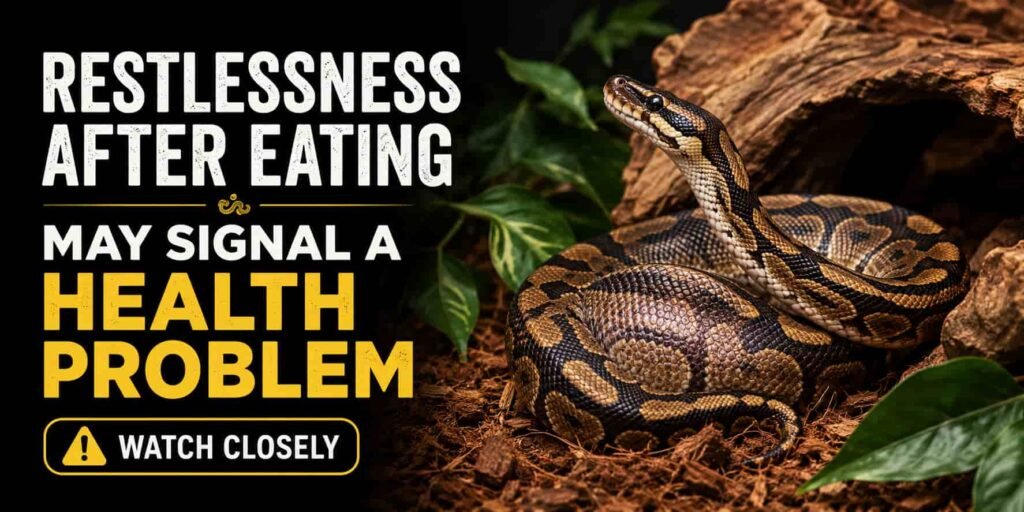
If your ball python becomes unusually active, restless, or uncomfortable after eating, it may be more than normal post-feeding behavior. While some movement can be harmless, sudden or repeated activity after a meal may suggest an underlying health issue, digestive discomfort, or snake illness.
A sick pet ball python may move around the enclosure because it feels stressed, painful, overheated, or unable to digest properly. This type of behavior should be watched carefully, especially if it happens often or comes with other signs such as refusing food, wheezing, regurgitation, weight loss, mouth bubbles, or unusual body posture.
Below are four possible medical causes that may explain why a ball python stays active after eating.
Regurgitation After Feeding
Regurgitation happens when a ball python brings its food back up before it has been fully digested. This is not normal and should always be taken seriously because it can stress the snake and affect its digestive health.
One common cause of regurgitation in ball pythons is handling too soon after feeding. After your snake eats, avoid touching, lifting, or moving it. Even gentle handling after feeding can disturb the digestion process and may cause your snake to throw up its meal.
If your ball python is active after eating, check the enclosure carefully to make sure it has not regurgitated. A regurgitated meal often has a strong, unpleasant smell, so you may notice the odor before you see it.
Post-feeding movement is not always dangerous, but if it happens with regurgitation, stress, loss of appetite, or repeated digestive problems, your snake may need better husbandry care or help from a reptile veterinarian.
Restlessness After Eating May Point to Health Issues
If your ball python becomes unusually active, restless, or unsettled after eating, it may be a sign that something is wrong. While mild movement after a meal can be normal, repeated or unusual post-feeding activity may suggest a possible health problem, digestive issue, or snake illness.
A sick pet ball python may move around the enclosure because it feels discomfort, stress, pain, or difficulty during digestion. This behavior should be watched carefully, especially if it happens often or appears with other warning signs such as regurgitation, loss of appetite, wheezing, weight loss, or unusual body movement.
Below are four possible medical reasons that may explain why a ball python stays active after eating.
Regurgitation After a Meal
Regurgitation happens when a ball python brings its food back up before it has been fully digested. This is different from normal digestion and can be stressful for your snake. It may also leave a strong, unpleasant smell inside the enclosure.
One common reason for ball python regurgitation is handling too soon after feeding. After your snake eats, avoid touching, lifting, or moving it. Even gentle handling after feeding can disturb the digestion process and may cause the snake to bring up its meal.
If your ball python is active after eating, check the enclosure carefully to make sure it has not regurgitated. You may notice the smell before you see the food. While some post-feeding movement can be normal, activity linked with regurgitation, stress, or repeated digestive problems should be taken seriously. In that case, review your feeding routine, prey size, temperature, and overall snake husbandry.
Restlessness After Eating and Possible Health Problems
If your ball python becomes unusually active or restless after eating, it may be reacting to discomfort or a possible health issue. While some movement after a meal can be normal, repeated or unusual post-feeding activity should be watched carefully. In some cases, this behavior may be linked to illness, digestive stress, or poor snake husbandry.
Regurgitation After Feeding
Regurgitation happens when a ball python brings its food back up before it is fully digested. This is a serious problem because it can stress the snake, weaken its body, and disturb the normal digestion process.
One common cause of ball python regurgitation is handling the snake too soon after a meal. After feeding, avoid touching, lifting, or moving your snake. Even light handling after feeding can upset its stomach and cause the meal to come back up.
If your ball python is active after eating, check the enclosure to make sure it has not regurgitated. A regurgitated meal often has a strong, unpleasant smell, so you may notice the odor before you see it.
If regurgitation, loss of appetite, stress, or repeated digestive problems happen again, review the prey size, feeding routine, temperature, and overall enclosure conditions. A reptile veterinarian may be needed if the problem continues.
Respiratory Infection Signs in Ball Pythons
Respiratory diseases can make a ball python feel uncomfortable, stressed, and unusually active after eating. Since ball pythons come from warm, tropical environments, they can be sensitive to poor temperature, low humidity, dirty enclosure conditions, or sudden habitat changes. These problems may increase the risk of a respiratory infection.
Unlike humans, snakes cannot cough to clear extra fluid from their respiratory tract. Because of this, mucus or fluid can build up and make breathing harder. If your pet ball python is wheezing, breathing loudly, making clicking sounds, or opening its mouth while breathing, it may be showing signs of a respiratory illness.
Other warning signs include bubbles around the mouth or nose, nasal discharge, drooling, low energy, and unusual post-feeding behavior. A snake with breathing trouble may move around the enclosure after eating because it feels stressed or uncomfortable.
If you notice any of these respiratory infection symptoms, contact a reptile veterinarian as soon as possible. Breathing problems in ball pythons should not be ignored, especially when they appear with restlessness after feeding, poor appetite, or signs of snake illness.
Breathing Problems and Temperature-Related Restlessness
Other signs of a possible respiratory infection include bubbles around the mouth or nose, nasal discharge, drooling, low energy, and unusual post-feeding behavior. A ball python with breathing difficulty may move around the enclosure after eating because it feels stressed, uncomfortable, or unable to rest properly.
If you notice any of these respiratory illness symptoms, contact a reptile veterinarian as soon as possible. Breathing problems in ball pythons should never be ignored, especially if they happen with restlessness after feeding, poor appetite, or other signs of snake illness.
Incorrect Enclosure Temperature After Feeding
A ball python may also become active after eating if the enclosure temperature is not correct. Since snakes are cold-blooded reptiles, they depend on outside heat to control their body temperature, digest food, and stay healthy.
The cool side of the snake enclosure should usually stay above 75°F / 24°C, while the warm basking area should be around 88–92°F / 31–33°C. If the habitat is too cold, your snake may struggle with digestion. If it is too hot, it may become stressed and move around trying to find a safer spot.
Keeping a proper temperature gradient helps your pet ball python choose the right area for thermoregulation, comfortable digestion, and normal post-feeding behavior.C).
If the Enclosure Is Too Cold
If the vivarium temperature is too low, your ball python may struggle to digest its meal properly. Because snakes are cold-blooded reptiles, they depend on external heat to keep their metabolism working at a healthy level.
When the enclosure is too cold, the snake’s digestion process can slow down too much. This may cause the food to sit in the stomach for too long, which can lead to regurgitation before the meal begins to break down or spoil inside the body.
After losing the meal, your ball python may become restless or more active because it feels hungry again and starts searching for food. This type of post-feeding activity can be a sign that the temperature gradient needs to be checked.
Read Also Ball Python Baby Chick Diet [Safe or Risky?]If the Enclosure Is Too Hot
If your ball python enclosure is too hot, your snake may keep moving toward the cool side of the habitat. This happens because the snake is trying to escape the heat and find a more comfortable place for thermoregulation.
Although ball pythons come from West and Central Africa, they are not desert reptiles. They naturally live in areas with grasslands, burrows, and some tree cover, not extremely hot desert conditions.
Too much heat can make your pet ball python feel stressed, uncomfortable, and unusually active, even after feeding. Instead of resting for digestion, it may move around the enclosure trying to find a safer and cooler hiding spot.
Restlessness After Eating Caused by Vibrations
A ball python may become active after feeding if it is disturbed by nearby sounds or ground vibrations. Even though ball pythons do not have visible ears, they can still detect certain low-frequency sounds. Their hearing is strongest around 80–160 Hz, and they may sense sounds up to about 1000 Hz.
However, vibrations often affect snakes more than normal sound. These vibrations can travel through the floor, furniture, or the enclosure. A ball python can feel them through its lower jaw, which helps snakes in the wild detect movement from possible predators or nearby danger.
If your pet ball python seems restless after eating, check the area around its habitat. Nearby construction work, road repairs, tree cutting, loud music, heavy bass, or drum practice may be creating vibrations that make your snake feel unsafe.
These outside disturbances can cause stress, restlessness, and unusual post-feeding behavior. Keeping the snake enclosure in a quiet, stable, and low-vibration area can help your ball python feel secure and digest its meal comfortably.
Final Thoughts on Ball Python Activity After Eating
If your ball python is active after eating, it may not always mean something is seriously wrong, but it is not the most common post-feeding behavior. Most ball pythons prefer to stay calm and rest while their body focuses on digestion.First, check whether your snake is getting the right prey size and following a suitable feeding schedule for its age, weight, and body condition. If the meal is too small, your pet ball python may still feel hungry and continue moving around the enclosure.
FAQs: Are Ball Pythons Active After Eating? [Must Know]
Do ball pythons move after eating?
Yes, ball pythons can move after eating, but most prefer to rest quietly while their body handles digestion. Each snake has different activity levels, so a little movement after a meal is usually normal. An active ball python does not always mean it is still hungry; it may simply be exploring, adjusting its position, or reacting to its environment..
How soon after eating can you handle a ball python?
You should wait at least 24 to 48 hours after your ball python eats before handling it. Touching or moving your snake too soon can cause stress, disturb digestion, and may lead to regurgitation, which can be dangerous. Also avoid handling when your python’s eyes look blue, cloudy, or opaque, because this usually means it is going into shedding and may feel more sensitive.
What do snakes do after eating?
After eating, snakes usually become less active because their body needs time for digestion. A snake may rest, hide, or stay still after a large meal. During this time, it can feel more vulnerable because it cannot move quickly. If handled or disturbed too soon, the snake may become defensive, feel stressed, or even regurgitate its food to escape danger. Therefore, it is best to leave a snake alone after feeding so it can digest safely.
What month are snakes most active?
Snakes are usually most active from March or April through October, especially during warm weather. They come out of brumation in spring when temperatures rise and become more active because they depend on external heat, sunlight, and warm surroundings to control their body temperature. Their activity often slows again when colder months return.
How does a ball python move?
A ball python moves by using strong body muscles and its belly scales to push, glide, and grip surfaces. Since it has no legs, hands, or feet, it relies on muscle control to crawl and climb. When handled, a ball python may gently wrap around your arms, hands, or body for balance, support, and stability, similar to how it would hold onto a tree branch.


![Why Does My Snake Pee on Me [Owner Guide]](https://reptilesinfo.com/wp-content/uploads/2026/06/Why-Does-My-Snake-Pee-on-Me-Owner-Guide.jpg)
![Why Is My Crested Gecko Going Crazy [Stress Alert]](https://reptilesinfo.com/wp-content/uploads/2026/06/Why-Is-My-Crested-Gecko-Going-Crazy-Stress-Alert.jpg)
![Why Is My Leopard Gecko Not Moving [Stress Alert]](https://reptilesinfo.com/wp-content/uploads/2026/06/Why-Is-My-Leopard-Gecko-Not-Moving-Stress-Alert.jpg)
![Why Is My Crested Gecko’s Mouth White [Danger Signs]](https://reptilesinfo.com/wp-content/uploads/2026/06/Why-Is-My-Crested-Geckos-Mouth-White-Danger-Signs.jpg)