
![Can Ball Pythons Drown [Safety Alert]](https://reptilesinfo.com/wp-content/uploads/2026/06/Can-Ball-Pythons-Drown-Safety-Alert.jpg)
If your ball pythons puts its head under the water for a short time, it is natural to wonder whether it can hold its breath underwater. Ball pythons are not commonly seen swimming, but they can stay underwater for several minutes when needed.
However, long or repeated soaking may mean something is wrong in the enclosure. Your snake may be trying to cool down, improve hydration, ease shedding, escape mites, or respond to poor temperature and humidity levels. In this guide, we will explain how long ball pythons can hold their breath, whether they can swim safely, and why your pet may be spending more time in its water bowl.
How Long Can a Ball Python Stay Underwater?
There is no clear scientific study that confirms the exact time a ball python can hold its breath underwater. However, many snake owners have reported seeing their pet snakes stay underwater for a few minutes, and in some cases, up to around 20 minutes.
If your ball python briefly puts its head underwater, it usually does not mean it is in immediate danger of drowning. These snakes can often hold their breath longer than humans. Still, if your python spends too much time in the water bowl, check the enclosure temperature, humidity levels, shedding condition, and possible mite problems, because long soaking can sometimes signal stress or discomfort.
Why Is My Ball Python Putting Its Head in Water?
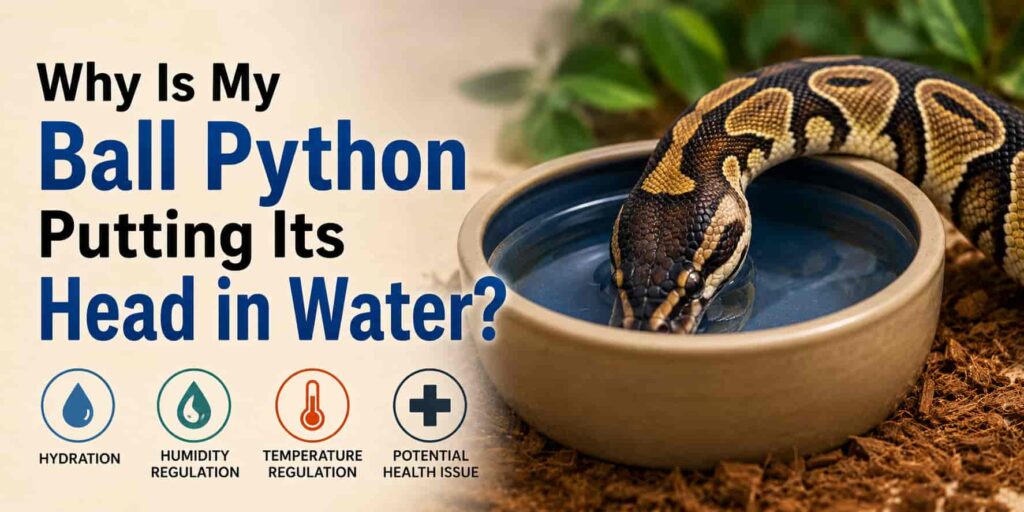
If your ball python keeps placing its head underwater, it may be a sign that something in the vivarium is not right. One common reason is incorrect temperature. Ball pythons are cold-blooded reptiles, which means they depend on their enclosure environment to control their body temperature.
Your snake’s vivarium should have a proper thermal gradient. The cool side should stay around 75–80°F, the warm side should be about 80–85°F, and the basking area should remain between 88–92°F. If the tank becomes too hot, your ball python may enter the water bowl or put its head underwater to cool down.
To keep your pet safe, always use a thermostat with the heat source and check the enclosure with digital thermometers. This helps you monitor the temperature range, prevent overheating, and keep your pet snake comfortable and healthy.
Read Also Do Bearded Dragons Need Belly Heat? [Care Tips]Incorrect Humidity Levels
Your ball python may put its head underwater if the humidity level inside the tank is too low. Ball pythons usually need around 50%–60% humidity, and this can be raised slightly during shedding to help the skin come off properly.
If the humidity drops below 50%, your snake may go to the water bowl to get extra moisture. However, humidity should not be too high either, because excess dampness can increase the risk of a respiratory infection.
A hygrometer is very useful for ball python owners because it helps you check the enclosure humidity quickly and keep your pet snake healthy, comfortable, and safe..
Dehydration in Ball Pythons
A ball python may spend too much time in its water bowl or put its head underwater if it is dehydrated. Common signs of dehydration include stuck shed, wrinkled skin, dented eye caps, and skin that does not quickly return to normal after being gently pinched.
Dehydration can happen when the humidity level is too low, the snake is not drinking enough fresh water, or the wrong type of water is used. Avoid distilled water or softened water, as they may not be ideal for your snake’s health. Always provide clean, fresh drinking water.
If your snake seems mildly dehydrated, a warm electrolyte soak may help. Use a shallow plastic tub with about one inch of warm water mixed with a reptile-safe electrolyte supplement, and keep the temperature around 82–84°F. Let your pet snake soak for 30–60 minutes under safe supervision. If the dehydration looks serious or does not improve, contact a reptile veterinarian.
Snake Mites and Water Soaking
One common reason a ball python may spend too much time in its water bowl is a mite infestation. Mites are tiny black external parasites that feed on a snake’s blood and can cause serious discomfort, stress, and skin irritation.
Your snake may soak or put its body underwater to try to escape the irritation caused by these parasites. However, soaking will not fully remove snake mites. If left untreated, mites can lead to poor health, weakness, infection, and in severe cases, they may even become life-threatening. Affected ball pythons should be treated quickly with safe reptile mite treatment and proper enclosure cleaning.
Signs of Mites in Ball Pythons
A ball python with mites may show clear signs of discomfort and stress. Common symptoms include rubbing against tank surfaces, loss of appetite, low energy, and frequent soaking in the water bowl. You may also see tiny black dots on your snake’s body or inside the enclosure.
These snake mites often gather around sensitive areas such as the eyes, ears, and cloaca. If you notice these signs, your ball python may have a mite infestation and should be treated quickly with safe reptile mite treatment and proper tank cleaning.ay see them on shed skin, on your hands after handling your ball python, or even moving around on the walls of your pet’s enclosure.
Read Also Why Beardies Jump When Held [Handling Mistakes]Safe Treatment for Mites in Ball Pythons
Snake mites can be hard to remove because they reproduce quickly and may return if the ball python and its enclosure are not treated properly. To control a mite infestation, you must clean both the snake and its living area. If you keep more than one snake, separate them and use quarantine because mites can easily spread between ball pythons.
Start by removing and throwing away all substrate. Take out every hide, bowl, branch, and accessory, then clean the whole tank carefully. Many keepers use reptile-safe mite treatment or a product recommended by a reptile veterinarian. Always follow the correct instructions, because strong chemicals can harm your snake if used wrongly.
After cleaning, use paper towels instead of loose substrate for a few weeks. This makes it easier to spot tiny black mites if they are still present. If no mites appear after about three weeks, you can return to your normal bedding. If the mites keep coming back, take your ball python to a reptile vet for proper treatment advice and safe medication.
Can Ball Pythons Swim Safely?
Ball pythons can swim, but they are not strong or natural water snakes. In the wild, they may swim only when necessary, such as to escape a predator or move through a difficult area. They do not usually swim for fun or regular activity.
In captivity, a ball python is more likely to soak in water to stay hydrated, help with shedding, cool down, or respond to stress in the enclosure. Always provide a clean, shallow water bowl that allows your snake to drink and soak safely without the risk of drowning.
Final Thoughts on Ball Pythons and Water
Ball pythons can hold their breath underwater, sometimes for several minutes and, in some cases, up to around 20 minutes. They can also swim, but they are not natural water snakes, so they usually do not swim unless they need to.However, frequent soaking or keeping the head underwater for too long may point to a problem in the enclosure. First, check the temperature and humidity levels. The cool side should be around 75–80°F, the warm side should be 80–85°F, and the basking area should stay between 88–92°F. Humidity should usually remain around 50%–60%.
FAQs: Can Ball Pythons Drown? [Safety Alert]
Can my ball python drown in water?
Yes, a ball python can drown if it becomes trapped in a water bowl and cannot climb out safely. This risk is higher for a young python or a small snake using a deep or poorly designed bowl. If you use a lidded water bowl, make sure the lid is not too tight and that your snake can enter and exit easily. Always provide a safe, shallow water dish to prevent accidental drowning and keep your pet snake protected.
Why is my snake trying to drown itself?
Your snake is probably not trying to drown itself. If it spends too much time soaking in water, it may be trying to relieve irritation caused by snake mites. These tiny external parasites can bite the snake, feed on its blood, and cause itching, stress, and skin discomfort. Frequent soaking, especially in a snake that does not normally stay in its water dish, can be a warning sign of a mite infestation. Check for tiny black dots around the eyes, scales, and enclosure, and treat the problem quickly with safe reptile mite treatment..
What is a silent killer snake?
The common krait is often called a silent killer snake because its bite can be extremely dangerous and may not cause strong pain at first. Its powerful neurotoxic venom can affect the nervous system, causing muscle paralysis, breathing problems, and damage to important body functions. Because of this, the common krait is considered one of the most medically important and deadly snakes, especially in parts of Thailand and South Asia.
How can you tell if a snake is dying?
It can be difficult to know if a snake is dying because snakes are quiet animals and often hide pain, illness, or weakness. Warning signs may include extreme lethargy, loss of movement, refusing food, severe weight loss, abnormal breathing, limp body posture, sunken eyes, or no response when touched. Age can help you understand your snake’s life stage, but it should not be the only sign. If your pet snake looks very weak or suddenly acts differently, contact a reptile veterinarian as soon as possible.
What will bring a snake out of hiding?
A snake may come out of hiding when the area feels calm and safe. The best approach is often to wait quietly, because snakes usually leave their hiding spot when they need food, water, or a safer place to rest. Reduce noise, avoid too much foot traffic, and keep the environment peaceful. This can help the snake feel less threatened and more likely to emerge naturally.


![Why Does My Snake Pee on Me [Owner Guide]](https://reptilesinfo.com/wp-content/uploads/2026/06/Why-Does-My-Snake-Pee-on-Me-Owner-Guide.jpg)
![Are Ball Pythons Active After Eating [Must Know]](https://reptilesinfo.com/wp-content/uploads/2026/06/Are-Ball-Pythons-Active-After-Eating-Must-Know.jpg)
![Why Is My Crested Gecko Going Crazy [Stress Alert]](https://reptilesinfo.com/wp-content/uploads/2026/06/Why-Is-My-Crested-Gecko-Going-Crazy-Stress-Alert.jpg)
![Why Is My Leopard Gecko Not Moving [Stress Alert]](https://reptilesinfo.com/wp-content/uploads/2026/06/Why-Is-My-Leopard-Gecko-Not-Moving-Stress-Alert.jpg)
![Why Is My Crested Gecko’s Mouth White [Danger Signs]](https://reptilesinfo.com/wp-content/uploads/2026/06/Why-Is-My-Crested-Geckos-Mouth-White-Danger-Signs.jpg)