
![Ball Pythons in One Tank [Risk Explained]](https://reptilesinfo.com/wp-content/uploads/2026/06/Best-Food-Bowl-Size-for-a-Tortoise.jpg)
Ball pythons are naturally solitary reptiles, so they do not need another snake for friendship, bonding, or emotional support. While many animals enjoy living in groups, this idea does not usually apply to ball python care. These snakes are happiest, safest, and least stressed when they live alone in their own secure enclosure.
Technically, two ball pythons can be placed in the same tank, but that does not mean they should be kept together. Sharing one snake habitat can cause stress, competition for space, feeding problems, and possible health risks. For this reason, keeping one ball python per enclosure is the safest and most responsible choice.
This guide explains how ball pythons behave in the wild, what can happen when they are housed together in captivity, and whether there is any safe way for them to cohabitate.
Do Ball Pythons Stay Together in Nature?
In the wild, ball pythons usually live alone. They may come together during the breeding season, but they do not form social groups or live as pairs. Sometimes, they may share a burrow for shelter, warmth, or safety, but this is usually due to necessity rather than social bonding.
Their natural behaviour shows that ball pythons are not social snakes. Keeping them in captivity does not change this instinct. Even in a clean and well-managed tank, they still prefer their own space, their own hides, and their own feeding area. Because of this, separate housing is the best way to protect their health, comfort, and well-being.
Risks of Keeping Ball Pythons in One Tank
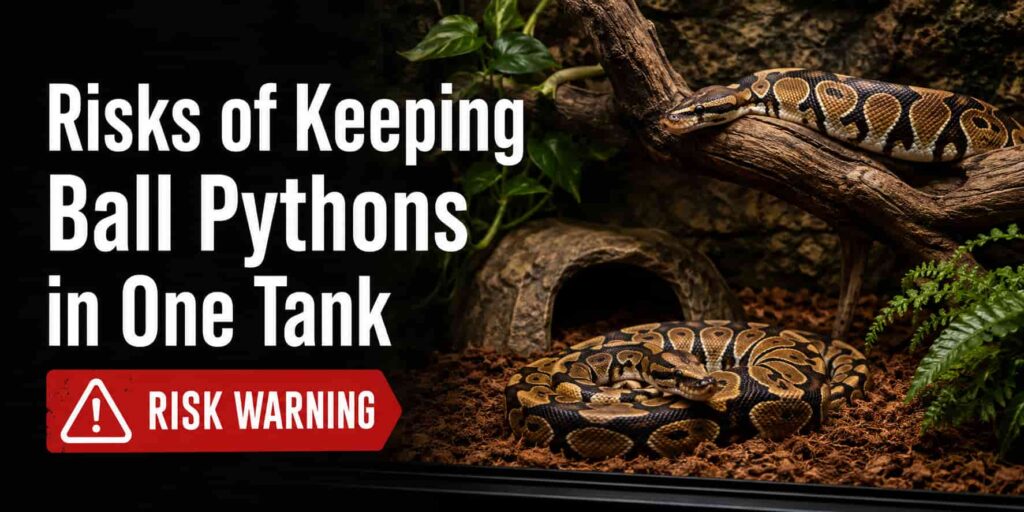
Keeping more than one ball python in the same enclosure may seem possible, but it is not recommended. In most cases, cohabitation creates more problems than benefits. Ball pythons are solitary snakes, and they usually feel safer when they have their own private space.
When two or more ball pythons share one tank, they may experience stress, competition, feeding issues, and dominance-related behaviour. In very rare cases, serious problems such as cannibalism have also been reported. For this reason, separate housing is the safest choice for responsible snake care.
Stress and Health Problems
Stress is one of the biggest risks of keeping multiple ball pythons together. Even if the snakes do not fight, the constant presence of another snake can make them feel unsafe. This low-level stress may continue for a long time and slowly affect their immune system, behaviour, and overall health.
A stressed ball python may become more vulnerable to illness because its body cannot defend itself properly. Common health problems linked with poor conditions and stress include mouth rot, parasites, respiratory infections, and septicemia. Some of these illnesses can become life-threatening if they are not treated quickly.
The best way to prevent these problems is to reduce stress before it starts. Giving each ball python its own clean, secure, and properly heated snake habitat helps protect its comfort, safety, and long-term well-being.
Read Also Why Is My Crested Gecko Licking His Bum? [Health Signs]Dominance Problems in Shared Enclosures
Ball pythons are not social snakes, so they usually do not treat each other as equal tank mates. When two ball pythons are kept in the same enclosure, one snake may try to become dominant, while the other becomes more submissive. This can create ongoing stress, discomfort, and health risks for the weaker snake.
Some dominant behaviours may look friendly at first. For example, two ball pythons may appear to be resting together in the basking area. It may look like they are cuddling, but this is usually not social bonding. In most cases, the dominant snake is lying on top of the submissive snake to control the best heat source, space, and tank resources.
This can prevent the submissive ball python from getting enough warmth. Without proper heat, basking time, and temperature control, the snake may face digestion problems, poor energy levels, and other health issues.
The same problem can happen with hides. A dominant ball python may claim the best hiding spots and force the weaker snake to stay in the open or hide under the substrate. This makes the submissive snake feel exposed, unsafe, and stressed.
Male and male pairs are especially risky because they may fight over territory, which can lead to serious injuries or even death. A male and female pair can also be unsafe because the male may repeatedly bother or dominate the female. Female and female pairs are sometimes seen as less risky, but even then, one female may still try to control the space and resources.
Feeding Competition and Food Stress
Feeding problems are another major risk of keeping more than one ball python in the same tank. Once one snake becomes dominant, it may treat all prey as its own. As a result, the submissive snake may not get enough food, nutrition, or energy to stay healthy.
Some keepers try to solve this by using a separate feeding tank, but this can create new problems. A separate feeding space takes extra time to prepare, clean, and manage. It also means the snakes must be moved before or after eating, which can increase stress and raise the chance of regurgitation.
Another common issue is food refusal. A stressed ball python may stop eating completely, especially when it feels unsafe in a shared snake habitat. In serious cases, ball pythons have gone without food for long periods because of stress caused by cohabitation.
For these reasons, each ball python should have its own clean, secure, and properly heated enclosure. Separate housing helps prevent dominance behaviour, feeding competition, stress-related illness, and long-term health problems.
Disease Risks in Shared Ball Python Tanks
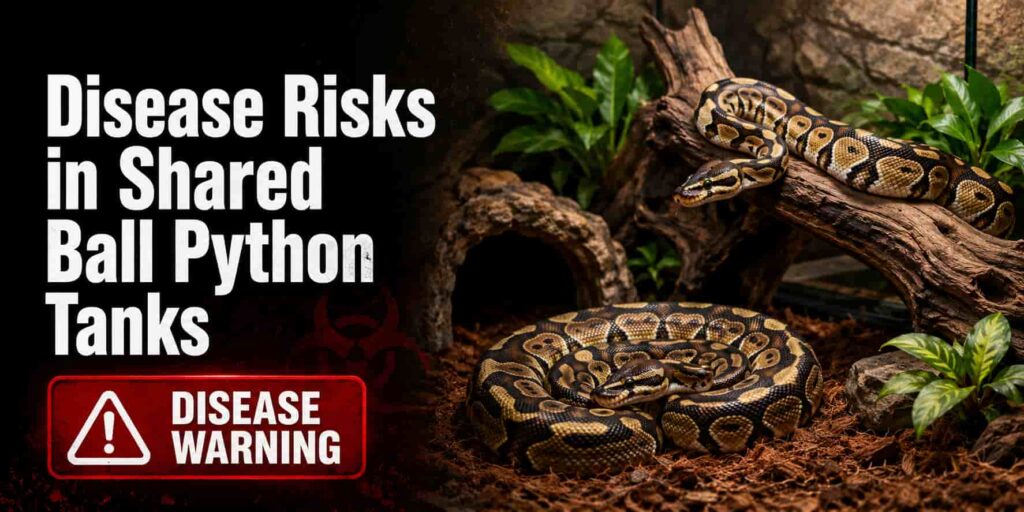
Keeping more than one ball python in the same enclosure can make disease control much harder. If one snake becomes sick, the illness can quickly spread to the others through shared space, contact, waste, water bowls, hides, or contaminated substrate. This can lead to higher veterinary costs, more care time, and serious health risks for all snakes in the tank.
Separate housing is much safer because it helps protect each ball python’s health and makes it easier to notice early signs of illness. One important way to check a snake’s condition is by observing its feces. Healthy stool can show that digestion is normal, while diarrhea may suggest parasites, infection, stress, or another health problem.
When multiple ball pythons live together, it becomes difficult to know which snake produced the stool. This can delay proper treatment and make it harder to identify the sick snake. For this reason, each ball python should have its own clean, secure, and well-maintained snake habitat.
Cannibalism and Size Differences
Although cannibalism is rare in ball pythons, it can still happen. The risk becomes higher when snakes of very different sizes are housed together. A larger ball python may see a much smaller snake as prey, especially if an adult is kept with a hatchling or young snake.
This situation can be dangerous and sometimes fatal. To avoid this risk, ball pythons of different sizes should never be kept in the same tank. Separate enclosures are the safest option for both young and adult snakes.
Read Also Why Is My Bearded Dragon Missing Nails? [Injury Signs]Breeding Does Not Mean Permanent Cohabitation
Some owners may think that a male and female ball python should live together if they want them to breed. However, ball pythons are still solitary reptiles, even during the breeding process. Mating does not mean they enjoy living together or need long-term companionship.
For breeding, the snakes only need to be introduced for the actual mating period under careful supervision. After that, they should be separated again. Keeping them together for too long can cause stress, dominance issues, feeding problems, and health risks.
The safest practice is to keep each ball python in its own properly heated and secure enclosure, only bringing them together temporarily when breeding is planned and conditions are suitable.
Can Ball Pythons Ever Share an Enclosure Safely?
In most cases, ball pythons should not live together. Most experienced snake keepers and reptile owners do not recommend cohabitation because the risks are usually greater than the benefits. However, some owners believe that multiple ball pythons may live together only if the enclosure is extremely large and carefully managed.
If someone attempts to keep more than one ball python in the same snake enclosure, space is the first major requirement. Each snake would need around 24 square feet of space, along with separate basking areas, several hides, enough cover, plants, branches, and climbing options. These features help reduce competition and give each snake a chance to move, hide, warm up, and feel secure.
Even with a large setup, keeping multiple ball pythons together is still difficult. A big enclosure requires more money, more cleaning, and careful control of temperature, humidity, heating zones, and overall habitat conditions. If these needs are not managed correctly, the snakes may become stressed or unhealthy.
Because of these challenges, successful ball python cohabitation is not something most owners should attempt. Separate housing remains the safer and more responsible choice.
Final Thoughts on Ball Python Cohabitation
Although it may be possible to keep more than one ball python in the same tank, it is not recommended for most owners. Ball pythons are naturally solitary reptiles, and even in the wild, they usually live alone unless they come together for breeding or shelter.When two or more ball pythons are forced to share one enclosure, they may experience stress, dominance behaviour, feeding competition, illness, and poor health. In rare cases, serious problems such as cannibalism can also happen, especially when snakes are very different in size.
FAQs: Ball Pythons in One Tank? [Risk Explained]
Can you keep ball pythons in the same tank?
No, ball pythons should not be kept in the same tank or enclosure. They are solitary reptiles and usually feel safer living alone. Keeping them together can cause stress, food competition, fighting, breeding pressure, injuries, and in rare cases, cannibalism. For their health and safety, each ball python should have its own separate habitat.
Is it safe to have two ball pythons together?
No, it is not safe to keep two ball pythons together. They are solitary snakes and do not need a tank mate. Sharing one enclosure can cause chronic stress, food competition, territorial pressure, and possible injury. Each ball python should live in its own separate habitat for better health, safety, and comfort.
Can snakes be in the same tank?
No, most pet snakes should not be kept in the same tank. Snakes are usually solitary reptiles and do not need companionship. Sharing one enclosure can lead to chronic stress, territorial behavior, food competition, fighting, and serious health risks. For safety, each snake should have its own separate habitat.
Are ball pythons safe to keep as a pet?
Yes, ball pythons are generally safe pet snakes when they receive proper care, handling, and a secure enclosure. They are usually calm, low-risk, and suitable for responsible keepers. However, they still need the right temperature, humidity, feeding routine, and regular health checks to stay comfortable and healthy.
Do snakes get bored in their enclosure?
Snakes may not feel boredom like humans, but they still need environmental enrichment. A plain, small, or empty enclosure can cause stress, low activity, food refusal, and repeated cage-pacing. Adding safe hides, climbing branches, substrate, and proper space helps keep a pet snake healthier and more comfortable.


![Why Does My Snake Pee on Me [Owner Guide]](https://reptilesinfo.com/wp-content/uploads/2026/06/Why-Does-My-Snake-Pee-on-Me-Owner-Guide.jpg)
![Are Ball Pythons Active After Eating [Must Know]](https://reptilesinfo.com/wp-content/uploads/2026/06/Are-Ball-Pythons-Active-After-Eating-Must-Know.jpg)
![Why Is My Crested Gecko Going Crazy [Stress Alert]](https://reptilesinfo.com/wp-content/uploads/2026/06/Why-Is-My-Crested-Gecko-Going-Crazy-Stress-Alert.jpg)
![Why Is My Leopard Gecko Not Moving [Stress Alert]](https://reptilesinfo.com/wp-content/uploads/2026/06/Why-Is-My-Leopard-Gecko-Not-Moving-Stress-Alert.jpg)
![Why Is My Crested Gecko’s Mouth White [Danger Signs]](https://reptilesinfo.com/wp-content/uploads/2026/06/Why-Is-My-Crested-Geckos-Mouth-White-Danger-Signs.jpg)