
![Turtle Tanks Near Windows Pros & Cons [Light, Stress]](https://reptilesinfo.com/wp-content/uploads/2026/06/Turtle-Tanks-Near-Windows-Pros-Cons-Light-Stress.jpg)
One important decision when adopting a turtle is choosing the right location for its tank. Many owners wonder whether placing the tank by a window with sunlight is ideal or if a darker room is better. Both options have implications for your turtle’s health and care.
Can a Turtle Tank Be Placed by the Window?
Yes, placing a turtle tanks near a window is possible, but it introduces challenges. Direct sunlight can lead to algae growth, and it may make temperature regulation harder. Understanding these effects is important for maintaining a healthy aquatic environment for your turtle.
Importance of UV Light
While sunlight has risks, turtles need UVB light to synthesize vitamin D3, which supports shell and bone health. If natural sunlight is limited, provide a UVB lamp to ensure your turtle receives adequate ultraviolet exposure.
Temperature Fluctuations
Turtles are ectothermic, or cold-blooded. This means that they rely on their environment to regulate their temperature, alternating between warm and cold areas in their habitat in order to maintain their body’s ideal state.
This is why it’s so important to provide a reliable heat source with a thermostat, as well as multiple digital thermometers to monitor your turtle tank’s temperature.
Many people really underestimate the power of natural sunlight through a window. It can warm up the water in your turtle tank very quickly! The water can easily overheat, which can then cause problems for your turtle.
Read Also Turtle Tank Placement Tips [Window Danger]Practical Ways to Control Turtle Tank Temperature
Keeping a turtle tank at a safe and stable temperature is important for your turtle’s health, comfort, hydration, and overall aquatic habitat. In the wild, turtles can move into deeper water, hide in mud, or migrate to cooler ponds when the weather becomes too hot. In a home aquarium, however, the water is usually not deep enough for turtles to cool themselves naturally.
To reduce temperature fluctuations, make sure the tank has proper ventilation so extra heat can escape. Avoid placing the turtle tank in direct sunlight, especially near a window, because sunlight can quickly increase the water temperature and make the enclosure too warm.
Some owners use ice cubes to cool the water during hot days, but this is not a long-term solution. It takes time, effort, and constant checking. A better option is to place background paper on the side of the tank that faces the window. This helps block some sunlight and may reduce how often you need to cool the water manually.
Background paper can also help turtles feel safer in their new environment. Glass tanks may confuse turtles because they can see their reflection, which may cause them to swim into the glass repeatedly. A background cover reduces this stress and also improves the tank’s appearance.
Another helpful method is adding artificial plants to the aquarium. These plants can block part of the sunlight, create shaded areas, and help keep the tank cooler. They also make the turtle enclosure look more natural and comfortable.
Overall, the best way to manage turtle tank heat is to use proper tank placement, ventilation, shade, background covering, and aquarium plants instead of relying only on ice cubes.
How to Control Algae in a Turtle Tank
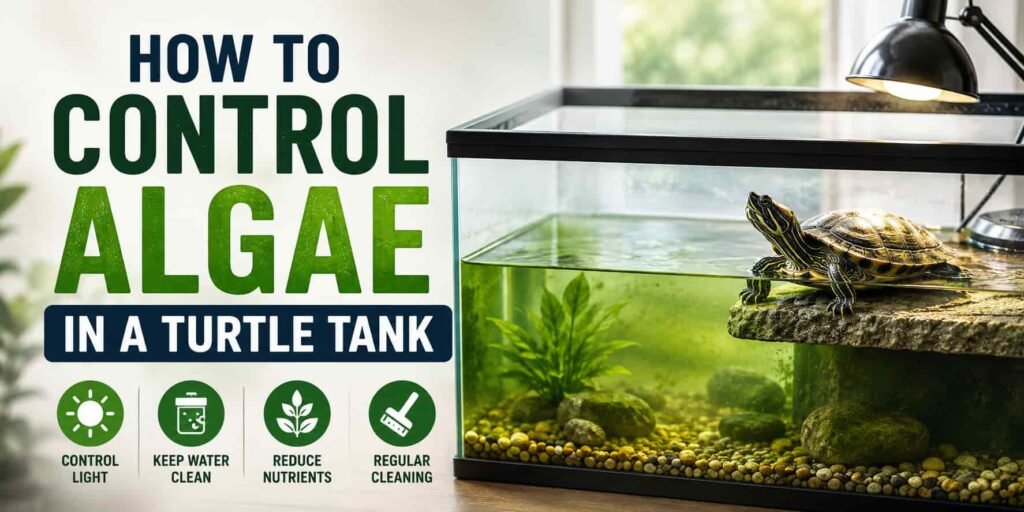
A turtle tank placed near a window may look bright and attractive, but direct sunlight can quickly increase algae growth. Algae can spread over the glass, decorations, substrate, and other tank surfaces. If it is not controlled, the water may look dirty, and the tank may need more frequent water changes.
Some algae is normal in every turtle aquarium, even when the tank is not near a window. The goal is not to remove every small spot of algae, because that is almost impossible. Instead, the main goal is to control it through regular tank maintenance, proper filtration, and safe cleaning habits.
The best way to manage algae is to follow a consistent cleaning schedule. Remove leftover food, waste, and floating debris every day with a small net. This helps keep the water quality better and slows down algae buildup.
A strong, high-quality aquarium filter is also very helpful. It will not completely stop algae, but it can reduce waste, improve water circulation, and slow down the growth of algae inside the turtle enclosure.
You should also check the tank water with pH test strips every few days. In most turtle tanks, the pH level should usually stay between 6 and 8. Heavy algae growth can affect the water’s pH, so testing is an important part of keeping your turtle’s aquatic habitat safe.
If the tank is close to a window, you may need a full water change once a week or even more often if algae grows fast. When cleaning the tank, never use regular soap, detergent, or harsh household chemicals. These can be dangerous for turtles. Use only a reptile-safe tank cleaner made for turtle or aquarium care.
To clean the tank properly, remove your turtle, decorations, plants, filter parts, and other accessories. Scrub away algae, dirt, and bacteria using a turtle-safe cleaning product. Rinse the tank well and let it dry for a few hours. Clean all accessories carefully before placing them back inside. If you use substrate, replace it when it becomes dirty or covered with algae.
After everything is clean, dry, and safely arranged, you can return your turtle to its tank. Always wash your hands before and after cleaning the turtle tank to protect both you and your pet from harmful germs and bacteria.
Overall, algae can be controlled by reducing direct sunlight exposure, using a strong filter, testing the water pH, removing waste daily, and following a proper tank cleaning routine.
Read Also Why Is My Ball Python Balled Up? [Stress Signs]Why Window Sunlight Cannot Replace UV Light for Turtles
Keeping a turtle tank near a window may seem like a natural way to provide sunlight, heat, and basking support, but window light does not replace a proper UV light. Although the tank may look bright, the glass blocks or filters out the important UVA rays and UVB rays that turtles need for healthy growth.
Turtles need UVA light to support normal body functions, including metabolism, activity, appetite, and natural behavior. They also need UVB light because it helps the body produce and use Vitamin D3, which allows the turtle to absorb calcium properly.
Without enough UVB exposure, a turtle may not grow correctly and can develop serious health problems, such as metabolic bone disease, weak bones, soft shell, poor shell development, and low energy. A lack of proper UV lighting can also weaken the immune system, making the turtle more likely to suffer from illness and other health issues.
Even if your turtle tank is placed near a sunny window, you should still use a high-quality reptile UVB lamp. The light should stay on for about 12 hours during the day and be turned off for 12 hours at night. This helps create a healthy day and night cycle, similar to what turtles experience in nature.
It is also important to replace the UV bulb regularly because UV output becomes weaker over time, even if the bulb still looks bright. Always follow the manufacturer’s instructions for safe distance, placement, and replacement timing.
Some owners may use Vitamin D supplements, but supplements must be given carefully because too much Vitamin D can be harmful. A proper UVB basking light is usually safer and more natural because it allows the turtle to regulate its own exposure while basking.
Overall, direct window sunlight is not enough for a turtle’s health, shell growth, calcium absorption, and immune function. A safe turtle setup should include proper UVB lighting, a warm basking area, clean water, and a regular light schedule.
Metabolic Bone Disease in Turtles
Metabolic bone disease is a serious health condition that can happen when a turtle does not get the right balance of calcium, Vitamin D3, and UVB light. Turtles need UVB rays to produce Vitamin D3, which helps their bodies absorb and use calcium properly. Without enough UVB exposure, their bones and shell may become weak.
This disease is common in turtles that do not have access to a proper reptile UVB lamp or a healthy basking area. Window sunlight is not enough because glass blocks most of the useful UVB rays.
Common signs of metabolic bone disease include swollen legs, small bumps along the legs or spine, a soft jaw, a soft shell, weakness, poor movement, and a jerky walking style. A turtle may also become lethargic, lose interest in food, or stop eating completely.
If these symptoms appear, the turtle should be taken to a reptile veterinarian as soon as possible. Metabolic bone disease can become life-threatening if it is not treated early.
Final Turtle Tank Care Tips
Placing a turtle tank near a window is possible, but it requires extra care. Direct sunlight can cause temperature changes, fast algae growth, and poor water quality if the tank is not maintained properly.To manage heat, use background paper, aquarium plants, proper ventilation, and a reliable thermostat to monitor the tank temperature. Ice cubes may help in an emergency, but they should not be the main cooling method.To control algae, keep a regular cleaning routine. Remove waste, floating algae, and uneaten food every day with a small net. Clean the tank, change the water, and wash all tank accessories weekly or more often if algae grows quickly.Most importantly, always provide a proper UVB light, a warm basking spot, clean water, safe filtration, and regular tank maintenance.
FAQs: Turtle Tanks Near Windows: Pros & Cons [Light, Stress]
Should my turtle tank be adjacent to a window?
No, your turtle tank should not be placed next to a window. Direct natural sunlight can raise the tank temperature, making it harder for your turtle to control its body temperature. It can also cause fast algae growth, which makes the tank look dirty and can reduce water quality.
What are the common problems with turtle tanks?
Common turtle tank problems include poor water quality, bad odors, dirty water, and weak filtration. Turtles create a lot of waste, so they need a strong filter, proper feeding routine, regular tank cleaning, and a safe basking area to keep their habitat healthy.
Do turtles need light 24 hours a day?
No, turtles do not need light all day and night. Constant lighting can harm their health and disturb their natural day-night cycle. Turtles need about 10 to 14 hours of light and 10 to 14 hours of darkness each day to support a healthy circadian rhythm, proper rest, and normal behavior.
Which directions should be avoided for placing an aquarium?
According to Vastu beliefs, an aquarium should not be placed in the south-east, south, or south-west direction. The south-east is linked with the fire element, so keeping water there is often considered unsuitable. It is also better to avoid placing an aquarium in the bedroom or under staircases, as these spots may affect peace, energy balance, and financial stability.
What are common turtle enclosure mistakes?
Common turtle enclosure mistakes include adding too many decorations or keeping the tank too empty. Too many objects make tank cleaning harder, while a bare setup gives your turtle fewer places to hide, explore, and feel safe. A healthy turtle habitat should have enough open space, safe hiding areas, and surfaces where beneficial bacteria can grow to help support better water quality.


![Why Does My Snake Pee on Me [Owner Guide]](https://reptilesinfo.com/wp-content/uploads/2026/06/Why-Does-My-Snake-Pee-on-Me-Owner-Guide.jpg)
![Are Ball Pythons Active After Eating [Must Know]](https://reptilesinfo.com/wp-content/uploads/2026/06/Are-Ball-Pythons-Active-After-Eating-Must-Know.jpg)
![Why Is My Crested Gecko Going Crazy [Stress Alert]](https://reptilesinfo.com/wp-content/uploads/2026/06/Why-Is-My-Crested-Gecko-Going-Crazy-Stress-Alert.jpg)
![Why Is My Leopard Gecko Not Moving [Stress Alert]](https://reptilesinfo.com/wp-content/uploads/2026/06/Why-Is-My-Leopard-Gecko-Not-Moving-Stress-Alert.jpg)
![Why Is My Crested Gecko’s Mouth White [Danger Signs]](https://reptilesinfo.com/wp-content/uploads/2026/06/Why-Is-My-Crested-Geckos-Mouth-White-Danger-Signs.jpg)