
![Types of Sea Turtles in Australia [Wild Facts]](https://reptilesinfo.com/wp-content/uploads/2026/06/Types-of-Sea-Turtles-in-Australia-Wild-Facts.jpg)
Australia is home to six types of sea turtles, making its waters an important place for marine biodiversity. These sea turtle species live in different coastal areas, coral reefs, seagrass beds, and open ocean habitats. Each species has its own physical features, feeding habits, and role in maintaining a healthy marine ecosystem.This article explains the main characteristics, natural habitats, and conservation status of Australia’s sea turtles. It also highlights why protecting these endangered marine reptiles is important for the future of ocean life, wildlife conservation, and Australia’s rich aquatic environment.Australia’s waters are rich with diverse marine life, including six distinct types of sea turtles. This article will explore the characteristics, habitats, and conservation status of these marine species. Each possesses unique attributes and plays a significant role in Australia’s marine ecosystems.
Which Sea Turtles Live in Australia?
Australia is home to six species of marine turtles. These are the Flatback Turtle (Natator depressus), Green Turtle (Chelonia mydas), Hawksbill Turtle (Eretmochelys imbricata), Leatherback Turtle (Dermochelys coriacea), Loggerhead Turtle (Caretta caretta), and Olive Ridley Turtle (Lepidochelys olivacea).
Each sea turtle species has different body features, feeding habits, nesting patterns, and habitat needs. Australia’s wide range of coastal waters, coral reefs, seagrass meadows, and marine environments provides important places for these turtles to live, feed, breed, and nest.
However, many of these marine reptiles face serious threats, including habitat loss, climate change, pollution, fishing activities, and disturbance near nesting beaches. Because of this, strong conservation efforts, wildlife protection, and marine ecosystem management are needed to help protect Australia’s sea turtles for the future.
Flatback Turtle: Australia’s Native Sea Turtle
The Flatback Turtle (Natator depressus) is a special sea turtle species found only in Australian waters, mainly around the Australian continental shelf. It gets its name from its flat, low-domed shell, which is different from the more rounded shells of many other marine turtles.
An adult Flatback Turtle can grow up to about 90 cm in carapace length. It usually has a broad, oval-shaped carapace and prefers coastal habitats, including shallow waters and areas near offshore reefs.
Unlike many other sea turtle species, the Flatback mainly feeds on soft-bodied marine animals, such as sea cucumbers, jellyfish, and other small invertebrates. Since it does not normally leave Australia’s surrounding seas, it is considered an endemic marine reptile and an important part of Australia’s marine biodiversity and coastal ecosystem.
Read Also Bearded Dragon Bites Tank Decor [Causes & Fixes]Green Turtle: A Seagrass-Loving Marine Reptile
The Green Turtle (Chelonia mydas) is a large sea turtle species commonly found in the warm coastal waters of Australia. It has a smooth, streamlined carapace that may appear olive or greenish-brown. However, its name comes from the green color of its body fat, which is linked to its mostly herbivorous diet.
Adult Green Turtles mainly eat seagrasses and algae, making them important for keeping seagrass beds healthy. By grazing on seagrass, they help maintain balanced marine ecosystems and support other forms of ocean life.
This Australian marine turtle is also known for its high-domed shell, small head, and strong, paddle-shaped flippers, which help it swim efficiently through the sea. Its feeding habits, body structure, and role in coastal biodiversity make it one of Australia’s most important marine reptiles.
Hawksbill Turtle: A Reef-Protecting Sea Turtle
The Hawksbill Turtle (Eretmochelys imbricata) is one of the six marine turtle species found in Australian waters. It is easily recognized by its sharp, bird-like beak and beautifully patterned carapace. This sea turtle can grow up to about one meter long and may weigh around 80 kilograms.
Hawksbill Turtles usually live in warm tropical waters, especially around coral reefs near the Australian coast. These reefs provide important feeding grounds, shelter, and natural marine habitats for the species.
Unlike many other sea turtles, Hawksbills mainly feed on sponges. This feeding habit helps control sponge growth and supports the health of coral reef ecosystems. By maintaining balance in reef environments, they play an important role in protecting marine biodiversity and supporting healthy ocean life.
Leatherback Turtle: The Largest Sea Turtle in Australian Waters
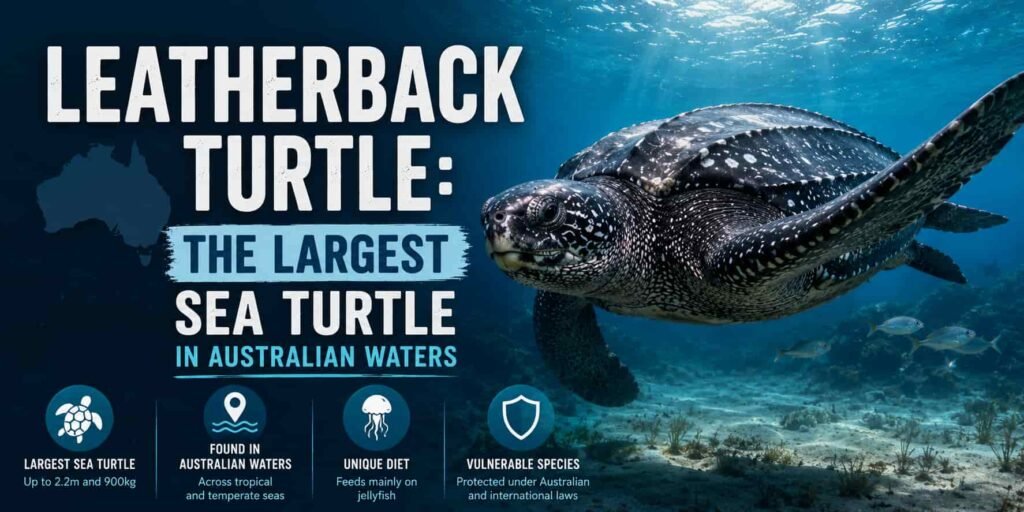
The Leatherback Turtle (Dermochelys coriacea) is the largest sea turtle species found in Australian waters. Unlike most marine turtles, it does not have a hard, bony shell. Instead, it has a flexible, leathery carapace, which gives this species its common name.
Leatherback Turtles mainly feed on jellyfish and other soft-bodied marine organisms. They are also known for their powerful long-distance migration, often travelling from warm tropical breeding areas to cooler temperate feeding grounds.
In Australia, Leatherbacks are mostly seen in the cooler waters of southern Australia, although they do not commonly nest there. These remarkable marine reptiles are listed as vulnerable under Australia’s Environment Protection and Biodiversity Conservation Act, meaning they need strong conservation efforts to protect them from threats such as pollution, climate change, fishing gear entanglement, and loss of suitable marine habitat.
Loggerhead Turtle: A Strong Ocean Traveller
The Loggerhead Turtle (Caretta caretta) is one of the main marine turtle species found in Australian waters. It is easily recognized by its large, powerful head and reddish-brown carapace. This sea turtle lives in both open ocean and coastal habitats, where it moves between feeding areas and nesting beaches.
Loggerhead Turtles are omnivorous, which means they eat both plant and animal matter. Their diet includes molluscs, crustaceans, jellyfish, and sometimes seagrass. Their strong jaws help them crush hard-shelled marine animals, making them well adapted to life in the sea.
These marine reptiles are known for their long-distance migration, travelling between feeding grounds and nesting sites, especially along the coast of Queensland. Sadly, the Loggerhead Turtle is listed as endangered because of serious threats such as commercial fishing, bycatch, habitat degradation, pollution, and disturbance near nesting beaches. Protecting this species is important for maintaining marine biodiversity and healthy coastal ecosystems.
Olive Ridley Turtle: A Small but Important Marine Species
The Olive Ridley Turtle (Lepidochelys olivacea) is one of the smaller sea turtle species found in Australian waters. It is known for its olive-colored, heart-shaped carapace, which gives this marine turtle its common name.
In Australia, Olive Ridley Turtles are seen less often than some other marine reptiles, but they are believed to live mainly in the warm tropical waters of northern Australia. These areas provide suitable marine habitats, feeding grounds, and coastal environments for their survival.
Olive Ridley Turtles are omnivores, meaning they eat both plants and animals. Their diet includes jellyfish, crustaceans, small fish, and algae. They are also famous for a rare mass nesting behavior called arribada, where large groups of females come onto beaches at the same time to lay eggs.
This species is considered vulnerable, which shows the need for strong conservation efforts, nesting beach protection, and better management of threats such as pollution, fishing bycatch, habitat loss, and climate change. Protecting the Olive Ridley Turtle helps support Australia’s marine biodiversity and healthy ocean ecosystems.
Read Also Bearded Dragon Euthanasia – Avoid Mistakes Every Owner Makes [Tips]Nesting Habits of Australian Marine Turtles
The nesting behavior of Australian marine turtles differs from species to species. Each sea turtle species chooses different nesting sites, lays a different number of eggs, and follows its own natural breeding pattern.
Flatback Turtles usually nest on sandy coastal beaches and lay about 50 eggs in each nest. Green Turtles often prefer quiet remote islands, coastal dunes, and protected beaches, where they may lay around 100 to 150 eggs. Hawksbill Turtles commonly nest near beachside vegetation, laying about 60 to 160 eggs.
Leatherback Turtles are highly migratory and can travel long distances between feeding grounds and nesting beaches, laying up to around 100 eggs. Loggerhead Turtles also use sandy beaches and dune areas, usually laying close to 100 eggs per nest.
Olive Ridley Turtles are especially known for their rare mass nesting event called arribada, where thousands of females come ashore together to lay eggs. During this synchronized nesting activity, each female may deposit about 100 eggs.
These different reproductive behaviors, nesting patterns, and egg-laying habits show how each turtle species has adapted to its own marine habitat, coastal environment, and survival needs.
Marine turtles in Australia face many serious threats, mostly caused by human activities. The main dangers include plastic pollution, habitat loss, illegal hunting, disturbance of nesting beaches, and accidental capture in fishing gear, known as bycatch. Climate change also creates major problems by raising sea levels, changing beach temperatures, damaging marine habitats, and affecting turtle nesting success.Public education is another key part of turtle protection. Awareness programs teach people about the importance of sea turtle conservation, reducing ocean pollution, protecting coastal habitats, and helping preserve Australia’s rich marine biodiversity for future generations.
To protect these important marine reptiles, Australia has introduced several conservation measures. These include strong wildlife protection laws, bans on poaching and harassment, and stricter rules for commercial fishing practices. Many non-profit organizations, rescue centres, and conservation groups also help by treating injured turtles, protecting nesting sites, monitoring turtle populations, and supporting marine ecosystem conservation.
How Turtle Feeding Habits Support Australia’s Marine Ecosystem
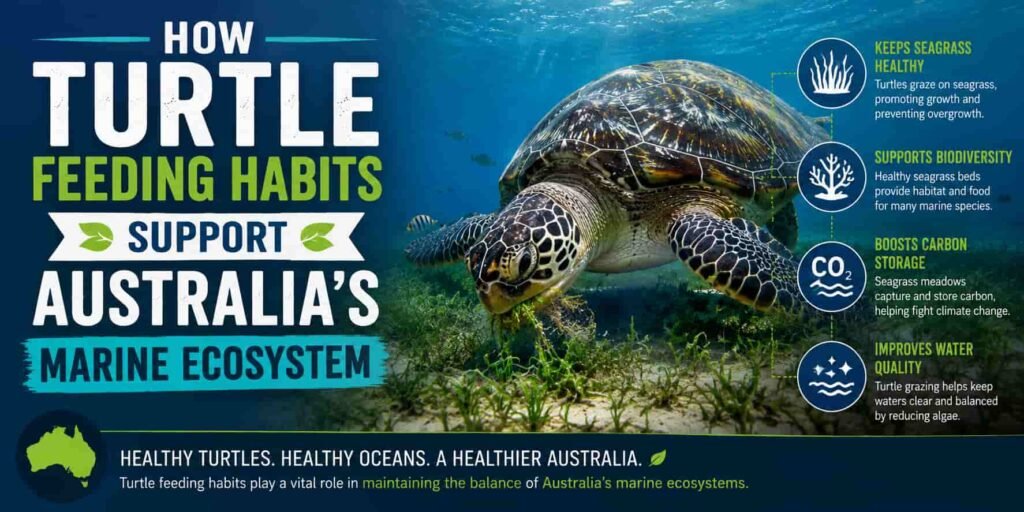
The feeding habits of Australia’s six marine turtle species play an important role in keeping the marine ecosystem healthy and balanced. Each sea turtle eats different types of food, which helps control species populations, support biodiversity, and maintain the natural food chain.
The Flatback Turtle mainly feeds on soft-bodied marine invertebrates, such as sea cucumbers, jellyfish, and shrimp. This helps regulate certain animal populations in coastal waters. The Green Turtle is mostly herbivorous and feeds on seagrass and algae, helping to keep seagrass beds healthy and productive.
The Hawksbill Turtle eats mainly sponges, which reduces competition for space on coral reefs and allows corals to grow. The Leatherback Turtle feeds mostly on jellyfish, helping to control jellyfish numbers in the ocean.
The Loggerhead Turtle eats mollusks, crustaceans, and small marine animals, while the Olive Ridley Turtle feeds on small invertebrates, fish, and algae. Together, these different diets help maintain ecological balance, protect marine habitats, and support the overall health of Australia’s ocean biodiversity.
Climate Change Impacts on Australian Marine Turtles
Climate change is one of the biggest threats to marine turtle populations in Australia. As sea levels rise, important nesting beaches can become smaller, damaged, or completely flooded. This reduces safe space for turtles to lay their eggs and can destroy existing nests, leading to lower hatching success.
Warmer temperatures also affect turtle reproduction. The sex of sea turtle hatchlings depends on the temperature of the sand during egg development. Higher nest temperatures can produce more female hatchlings, creating an uneven sex ratio that may affect the long-term survival of these marine reptiles.
Climate change can also increase storms, raise ocean temperatures, disturb migration routes, and reduce the availability of important food sources such as seagrass, jellyfish, and other marine organisms. Together, these changes create serious challenges for Australia’s six sea turtle species, making conservation efforts, nesting beach protection, and marine habitat management more important than ever.
Read Also Why Does My Turtle’s Water Look Oily? [Dirty Tank Signs]Cultural Importance of Marine Turtles to Indigenous Australians
Marine turtles hold deep cultural, spiritual, and traditional importance for many Indigenous Australian communities, especially those living near coastal waters and marine environments. In many communities, turtles are connected to ancestral stories, Dreaming traditions, customs, ceremonies, rituals, and storytelling.Turtles are often shown in Indigenous art and may be respected as totems or important cultural symbols. Their presence can also be seen as a sign of a healthy marine ecosystem, showing the close relationship between First Nations knowledge, sea Country, and ocean biodiversity.
FAQS: Types of Sea Turtles in Australia [Wild Facts]
How many types of sea turtles are there in Australia?
Australia is home to six marine turtle species out of the world’s seven. These include the Green Turtle (Chelonia mydas), Loggerhead Turtle (Caretta caretta), Flatback Turtle (Natator depressus), Hawksbill Turtle (Eretmochelys imbricata), Olive Ridley Turtle (Lepidochelys olivacea), and Leatherback Turtle (Dermochelys coriacea). These sea turtles are an important part of Australia’s marine biodiversity and coastal ecosystems.
What sea turtle is only found in Australia?
The Flatback Turtle (Natator depressus) is the only sea turtle species found only in Australia. It mainly lives in the waters around the continental shelf of northern Australia, making it an important endemic marine turtle in Australia’s coastal ecosystem.
What are the 7 types of sea turtles in the world?
There are seven species of sea turtles in the world: Flatback Turtle, Green Turtle, Hawksbill Turtle, Leatherback Turtle, Loggerhead Turtle, Olive Ridley Turtle, and Kemp’s Ridley Turtle. These marine turtles live in most of the world’s oceans, except the Arctic, and many are highly migratory, travelling long distances between feeding grounds and nesting beaches.
Are there wild turtles in Australia?
Yes, Australia has many wild turtles, including about 23 species of freshwater turtles. Most of these Australian freshwater turtles belong to the Chelidae family, a group mainly found in Australasia and South America. These turtles live in natural rivers, lakes, wetlands, and other freshwater habitats.
Can turtles hear human voices?
Yes, turtles can hear some human voices and other sounds, but they do not understand words like people do. Sea turtles, including Hawaiian green sea turtles or honu, can sense sound vibrations, tone, and volume, which helps them respond to their surroundings and stay aware of changes in their marine environment.


![Why Does My Snake Pee on Me [Owner Guide]](https://reptilesinfo.com/wp-content/uploads/2026/06/Why-Does-My-Snake-Pee-on-Me-Owner-Guide.jpg)
![Are Ball Pythons Active After Eating [Must Know]](https://reptilesinfo.com/wp-content/uploads/2026/06/Are-Ball-Pythons-Active-After-Eating-Must-Know.jpg)
![Why Is My Crested Gecko Going Crazy [Stress Alert]](https://reptilesinfo.com/wp-content/uploads/2026/06/Why-Is-My-Crested-Gecko-Going-Crazy-Stress-Alert.jpg)
![Why Is My Leopard Gecko Not Moving [Stress Alert]](https://reptilesinfo.com/wp-content/uploads/2026/06/Why-Is-My-Leopard-Gecko-Not-Moving-Stress-Alert.jpg)
![Why Is My Crested Gecko’s Mouth White [Danger Signs]](https://reptilesinfo.com/wp-content/uploads/2026/06/Why-Is-My-Crested-Geckos-Mouth-White-Danger-Signs.jpg)