
![Types of Snakes in Minnesota [Easy ID Guide]](https://reptilesinfo.com/wp-content/uploads/2026/06/Types-of-Snakes-in-Minnesota-Easy-ID-Guide.jpg)
sankes inMinnesota is a naturally rich state with forests, wetlands, rivers, and thousands of lakes. Because of these natural habitats, the state supports many forms of wildlife, including reptiles, amphibians, and different snake species.
Minnesota is home to about 30 types of reptiles and 20 types of amphibians, making it an interesting place for anyone who enjoys herping, snake identification, or learning about native animals.
Whether you are planning an outdoor field trip or simply want to understand more about snakes in Minnesota, this guide is a helpful starting point. It explains the state’s 14 main snake species, along with a few important subspecies, in a clear and easy way.
By the end, you will know how to recognize, compare, and understand the different Minnesota snakes found across the state.
Brown Snake Identification and Facts
The brown snake, also called De Kay’s snake, is a small non-venomous snake found across parts of North America, including Minnesota. Its scientific name is Storeria dekayi, and it belongs to the Colubridae family.
This native snake species usually lives in woodlands, marshes, prairies, rocky areas, and other moist natural habitats. Minnesota’s forests, lakes, wetlands, and rocky ridges provide suitable conditions for this harmless reptile.
Adult brown snakes are usually about 10 to 12 inches long. They have a slim body, a small head, a short snout, round pupils, and rough-looking keeled scales. Their body color is often grayish brown, yellowish brown, or light brown. A pale stripe usually runs along the center of the back, with small dark and light spots on both sides. The belly is commonly light brown or pale pink.
The brown snake is calm and rarely aggressive. It does not pose a danger to humans or pets. Its diet mainly includes small invertebrates such as worms, snails, slugs, and mites.
Unlike many snakes that lay eggs, the brown snake is viviparous, which means it gives birth to live young. Its conservation status is Least Concern, so it is not currently considered threatened.n’t lay eggs but gives birth to living young.
Read Also Tortoise Ate Dog Poop? [What Owners Must Know]Bullsnake Identification and Behavior
The bullsnake, also known as the gophersnake, is a large non-venomous snake found in many parts of the United States, including Minnesota. Its scientific name is Pituophis catenifer sayi, and it is a subspecies of the gopher snake.
Bullsnakes are among the largest native snakes in North America. Most adults grow between 4 and 6 feet, but some can reach more than 8 feet. They have a strong, muscular body, a rounded tail, a short sloping snout, and rough keeled scales.
This snake species is usually yellow or light tan with dark brown, black, or reddish blotches along the back. These markings often look like chain-like bands, which is why the name catenifer means “chain-bearing.” Smaller dark spots may also appear along the sides of the body.
Because of its size, pattern, and defensive behavior, the bullsnake is often mistaken for a rattlesnake. However, it is harmless to humans. When scared, it may lift part of its body, hiss loudly, and make a fake strike. These actions are mainly used to scare predators, not to attack.
Bullsnakes are powerful constrictors. They feed mostly on small rodents, amphibians, reptiles, birds, and bird eggs. They are also good climbers and may enter trees to search for food. Overall, the bullsnake is an important wildlife species because it helps control rodent populations naturally.
Common Garter Snake Identification and Facts
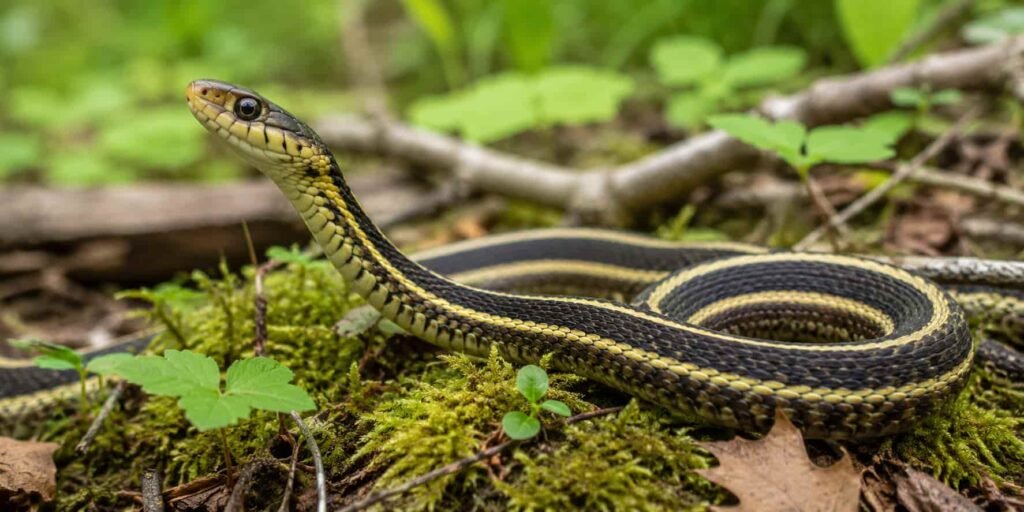
The common garter snake is one of the most widespread non-venomous snakes in the United States, including Minnesota. It includes several subspecies, with the Eastern garter snake and red-sided garter snake being among the most common in the state.
These native snakes are medium-sized and have slim bodies, average heads, and rough keeled scales. The Eastern garter snake is usually brown, dark green, or black, with a yellow or white stripe running down the middle of the back. Its belly is often yellow or pale. The red-sided garter snake is usually darker, with a yellow back stripe and red marks along the sides.
Common garter snakes are generally calm around humans. They are not dangerous, although they have mildly toxic saliva that helps them catch small prey such as toads, lizards, and other small animals. Their bite is not a serious threat to people. When frightened, they may make a fake strike or release a strong-smelling musk to protect themselves.
Their diet includes amphibians, reptiles, invertebrates, fish, small rodents, and young birds. Some garter snakes can also store toxins from poisonous newts they eat, which may make them unpleasant or harmful to predators.
Common garter snakes are ovoviviparous, meaning the female keeps the eggs inside her body until the young are ready to be born. This makes their reproduction different from many egg-laying snake species.
Eastern Hognose Snake Identification and Behavior
The Eastern hognose snake is a medium-sized non-venomous snake found in parts of Minnesota, southern Canada, and the northeastern United States. It is sometimes called the black viper snake, but it is not dangerous to humans. Its mild venom is mainly used to control amphibian prey and may only cause minor local swelling in people.
This snake species is easy to recognize because of its strong body, thick neck, wide flat head, and short upturned snout. The special nose shape helps it dig in loose soil, making it a good burrowing snake.
The Eastern hognose can appear in many colors, including green, brown, gray, black, orange, and red. Its body may be plain, checkered, or covered with dark blotches. It usually lives in sandy or loose-soil habitats, where it can dig and lay eggs.
Its diet mainly includes toads, frogs, and salamanders. It is highly adapted to eating amphibians and has natural resistance to bufotoxins, the toxins found in many toads.
Eastern hognose snakes are usually calm around humans and rarely bite. When threatened, they may hiss, flatten the head, or make a fake strike. If this does not work, they often play dead by rolling onto their back and leaving the tongue out. This dramatic defense behavior helps them avoid predators.
Lined Snake Identification and Habitat
The lined snake is a small non-venomous snake found in the central United States, including parts of Minnesota. Its scientific genus is Tropidoclonion, and it includes several recognized subspecies.
This snake species looks similar to a garter snake. Its body color may be green, brown, or dark gray, with three pale stripes running along the body: one on the middle of the back and one on each side. It has a slim body, small head, small eyes, and a narrow jaw.
A clear way to identify the lined snake is by looking at its underside. Unlike garter snakes, it has two rows of black half-moon marks running from the neck to the tail. These ventral markings help separate it from similar striped snakes.
The lined snake is calm, shy, and not dangerous to humans. It does not have venom for killing prey. Its diet mainly includes small invertebrates, especially earthworms.
This snake is semifossorial, meaning it spends much of its time underground. It prefers moist soil and often hides under rocks, logs, leaves, and other ground cover. Because of its small size, quiet behavior, and burrowing habit, it is rarely seen.
Although the lined snake is listed as Least Concern overall, it has been considered a species of special concern in Minnesota. Records from the state are limited, with sightings mainly linked to Blue Mounds State Park in Rock County. Continued conservation efforts are important because its local population appears to be low.
Milk Snake Identification and Key Facts
The milk snake is a small to medium-sized non-venomous snake found mainly in the eastern United States, including Minnesota. The type most often seen in Minnesota is the Eastern milk snake, known scientifically as Lampropeltis triangulum triangulum.
This snake species is easy to recognize because of its bold color pattern. It usually has a gray or tan body with large brown or reddish saddle-shaped blotches running from the head to the tail. These markings often have thin black borders. The belly is pale and may have dark spots that sometimes look like a checker pattern. Milk snakes also have smooth scales and a small head.
Milk snakes are harmless to humans and are popular among reptile enthusiasts. They are nonvenomous, have small teeth, and are usually shy, calm, and mostly nocturnal.
Their diet mainly includes small rodents such as mice and rats. Young milk snakes may also eat earthworms, slugs, insects, and other small invertebrates.
Milk snakes are oviparous, which means they lay eggs. In the wild, they can live up to about 15 years, while captive milk snakes may live longer. Because they are common in the reptile pet trade, captive-bred milk snakes can appear in many different colors and patterns compared to wild snakes.
Read Also Black Snakes in Pennsylvania [Scary but Useful]Blue Racer Identification and Behavior
The blue racer, also called the North American racer, is a non-venomous snake and a subspecies of the Eastern racer. Its scientific name is Coluber constrictor, and it is found in parts of Minnesota, Iowa, and the East North Central region of the United States.
In Minnesota, blue racers are often found near water, especially around the Mississippi, St. Croix, and Minnesota River valleys. They prefer quiet natural habitats with low human disturbance, but they may also appear near homes, barns, garages, foundations, and porches.
This snake species is known for its blue color. The sides of the body are usually bright blue, while the back is often dull blue-gray or slightly brownish. The belly is pale cream. Blue racers may also have a dark, mask-like marking on the head, and some have an orange-colored snout.
Blue racers are active during the day and mostly live on the ground, but they can climb trees and other vertical surfaces when searching for food. Their diet includes rodents, birds, bird eggs, frogs, toads, and smaller snakes.
Although blue racers are not venomous and are not true constrictors, they can become defensive if handled or threatened. They may bite quickly, strike more than once, release a bad-smelling musk, or defecate as a defense. They are also known for their speed and can move faster than many other snake species when escaping predators.
Northern Water Snake Identification and Habitat
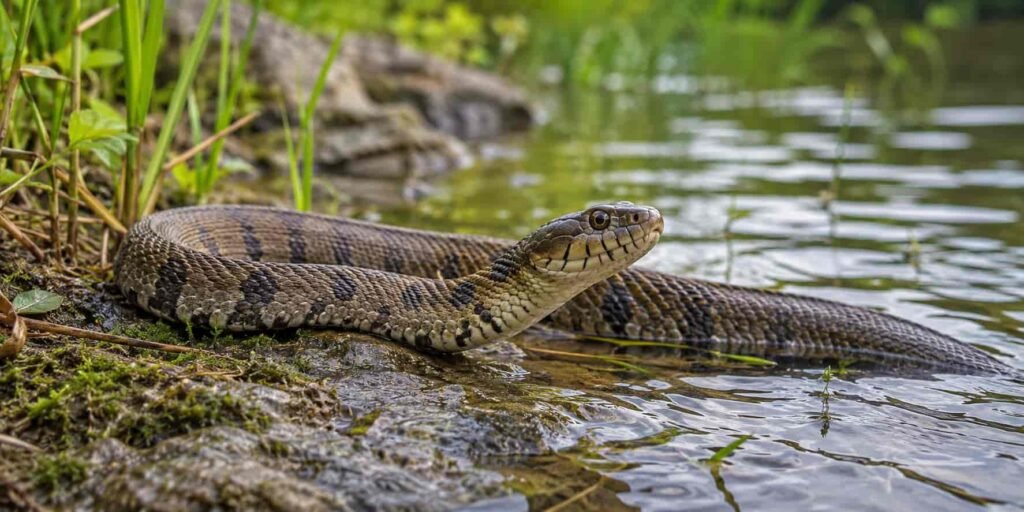
The northern water snake is a non-venomous snake and a subspecies of the common water snake. Its scientific name is Nerodia sipedon, and it is found in parts of the northeastern United States, southern Ontario, and Minnesota. In Minnesota, it commonly lives near the St. Croix River and Mississippi River valleys.
This snake species is often confused with the venomous cottonmouth because both can look dark and heavy-bodied. However, the northern water snake is harmless to humans. It usually has a gray, tan, or brown back with dark saddle-shaped blotches. These markings are clearer in young snakes and may fade as the snake gets older. Its belly is white, gray, or yellow, often with dark crescent-shaped marks. The rough-looking skin comes from its keeled scales.
A helpful way to tell it apart from a cottonmouth is by looking at the head and eyes. Northern water snakes have round pupils, a narrower head, and a rounded snout, while cottonmouths have more viper-like features.
Northern water snakes usually live near ponds, rivers, lakes, marshes, and other aquatic habitats. They often bask on rocks, logs, or shorelines and hunt in or near water. Their diet includes small fish, tadpoles, frogs, worms, leeches, turtles, and other aquatic prey.
Although they are not venomous, they can be defensive when handled. If threatened, they may bite, release a bad-smelling musk, or defecate to escape predators.
The northern water snake is ovoviviparous, meaning the female keeps the eggs inside her body until the young are ready to be born alive.
Plains Garter Snake Identification and Facts
The plains garter snake is a non-venomous snake found across the central United States, from Texas to Minnesota. Its scientific name is Thamnophis radix, and it belongs to the same genus as the common garter snake.
This snake species lives in many of the same habitats as other garter snakes, including grasslands, wetlands, open fields, and areas near water. It has a slim body, small head, and rough keeled scales.
The plains garter snake usually has a dark brown or greenish-brown back with a bright yellow or orange stripe running down the center. It also has wide yellow or greenish-yellow stripes along the sides. Its belly is often pale gray, yellowish, or greenish.
Although it has mildly toxic saliva for catching small prey, it is not dangerous to humans. A bite may cause slight swelling or itching, but this snake is shy and usually avoids biting unless handled or threatened.
Plains garter snakes are viviparous, meaning females give birth to live young instead of laying eggs. They also have strong cold tolerance for a reptile and may sometimes be seen basking during warm winter days.
Their diet mainly includes slugs, earthworms, leeches, toads, and small salamanders. This makes them useful in the ecosystem because they help control small invertebrates and amphibians.
Plains Hognose Snake Identification and Behavior
The plains hognose snake is a small non-venomous snake found in several parts of the United States, including Minnesota. Its scientific name is Heterodon nasicus, and it is different from the Eastern hognose snake.
This snake species is known for its short, upturned snout, which helps it dig in sandy or loose soil. It has a stout body, rough keeled scales, and a narrow head that is almost the same width as the neck.
Wild plains hognose snakes usually have natural earth-toned colors, such as yellowish, tan, sandy brown, or greenish shades. Their back is covered with dark blotches that may look similar to a rattlesnake pattern. Because of selective breeding in the reptile pet trade, captive-bred hognose snakes can appear in many color forms, including albino, orange, pink, and axanthic morphs.
Plains hognose snakes are usually calm and rarely bite. When threatened, they may use several defensive behaviors, such as bluff striking with a closed mouth, hissing, puffing up the body, or playing dead. These actions are meant to scare predators, not harm people.
Overall, the plains hognose snake is a shy, harmless, and interesting native snake with strong burrowing habits and a unique appearance.
Rat Snakes Found in Minnesota
Rat snakes are a large group of non-venomous snakes with many related species. In Minnesota, the most notable type is the Western rat snake, scientifically known as Pantherophis obsoletus.
The Western rat snake is a large, strong snake species that usually grows between 3.5 and 6 feet long. Adults are mostly black on the back, while the chin, throat, and upper body are lighter underneath. The lower belly becomes darker closer to the tail. Young rat snakes look different because they usually have a gray body with brown markings.
This native snake is not venomous, but it is a powerful constrictor. It catches prey by wrapping around it rather than using venom. Its diet includes mice, rats, voles, squirrels, chipmunks, young rabbits, birds, and sometimes other small animals.
Western rat snakes are highly adaptable. They can climb trees, move through rocky areas, and swim when needed. Their habitats may include forests, river valleys, lake edges, marshes, rocky places, barns, and other areas where small rodents are common.
Although they help control rodent populations, Western rat snakes can become defensive if disturbed. Like many wild reptiles, they should be observed from a safe distance and not handled.
Western Fox Snake Identification and Facts
The Western fox snake is a large non-venomous snake found in parts of Minnesota. Its scientific name is Pantherophis ramspotti. Adults usually grow about 3 to 4 feet long.
This snake species often has a gray, tan, or brown body with dark saddle-shaped blotches along the back. Its belly is usually yellow with dark markings. Some Western fox snakes have an orange-colored head, which can make people mistake them for a copperhead. However, this snake is harmless to humans.
Western fox snakes are often seen in forests, grasslands, wetlands, pastures, and farmlands, especially near water. They help farmers and the local ecosystem by eating mice and other rodents that may damage crops.
Although they are not venomous, they may become defensive when threatened. They can shake their tail, strike repeatedly, or act bold to scare away predators. Like all wild reptiles, they should be left alone and watched from a safe distance.
Read Also Types of Sea Turtles in Australia [Wild Facts]Northern Redbelly Snake Identification and Facts
The Northern redbelly snake is a small non-venomous snake found in Minnesota, southern Canada, and the eastern United States. Its scientific name is Storeria occipitomaculata occipitomaculata.
This native snake is usually less than 12 inches long. Its back may be brown, gray, or black, while its underside is reddish, which gives the species its common name. It also has rough keeled scales, a slim body, a narrow head, round pupils, and a thin neck.
Northern redbelly snakes prefer moist habitats, including wetlands, damp woodlands, gardens, and other high-humidity areas. Their diet mainly includes snails, slugs, and earthworms, so they are often found where these small invertebrates live.
This snake is harmless to humans and pets. It has very small teeth and rarely bites. When scared, it may show its teeth, go limp, or play dead to avoid predators.
Ringneck Snake Identification and Habitat
The ringneck snake is a small non-venomous snake found across North America, including Minnesota. The two main subspecies found in Minnesota are the Prairie ringneck snake and the Northern ringneck snake.
Both types are usually 10 to 15 inches long. They have slim bodies, narrow heads, and smooth scales. Their most noticeable feature is a yellow or orange ring around the neck.
The Prairie ringneck snake usually has a dark head, gray body, and a yellow or orange neck band. Its belly may fade from red near the tail to yellow near the throat, often with small black spots. The Northern ringneck snake is usually dark gray from head to tail, with a yellow or orange neck ring and a plain belly without dark spots.
Ringneck snakes prefer moist, covered habitats such as grass, leaf litter, logs, rocks, and shaded ground areas. They are mostly nocturnal, meaning they are active at night. Their diet includes insects, small amphibians, salamanders, lizards, and smaller snakes.
These native snakes are shy and calm. They rarely bite and usually try to escape when threatened.
Smooth Green Snake Identification and Facts
The smooth green snake, also called the grass snake, is a small non-venomous snake known for its bright green body and smooth scales. It has a slim body, tiny narrow head, and a yellowish or white belly.
This snake species usually lives in grassy, green, and well-covered habitats, where its color helps it blend into the environment. Its diet mainly includes small invertebrates such as spiders, ants, snails, slugs, worms, caterpillars, and moths.
Smooth green snakes do not use venom or strong constriction to catch prey. They are very gentle around humans and are unlikely to bite. If frightened, they may flee, play dead, coil around a hand, or release a bad-smelling musk.
Although the smooth green snake is listed as Least Concern overall, some experts believe its wild population is declining because of habitat loss, pesticide use, and herbicide exposure. Several U.S. states protect this species, but it is not currently listed as a species of concern in Minnesota.
Final Thoughts on Minnesota Snakes
Minnesota is a great place to learn about native snakes, reptiles, and local wildlife. The state has more than a dozen snake species, and most of them are non-venomous, calm, and not dangerous to humans.Each Minnesota snake has its own appearance, behavior, and preferred habitat. Some live near water, some stay in forests or grasslands, and others prefer moist soil, rocks, or hidden ground cover.By understanding their colors, markings, body shape, and behavior, it becomes easier to identify rat snakes, garter snakes, hognose snakes, milk snakes, and other common snakes found in Minnesota. This knowledge can help you explore nature safely and respect these important animals in the ecosystem.
FAQS: Types of Snakes in Minnesota [Easy ID Guide]
What does Minnesota have for snakes?
Minnesota has several native snake species, including two venomous rattlesnakes and many nonvenomous snakes. Rattlesnakes have segmented tails, while nonvenomous snakes usually have tails that taper to a point.
Are corn snakes in Minnesota?
Corn snakes are not usually found in Minnesota. They mostly live in the eastern and south-central United States and are listed as a Least Concern snake species because their population is stable.
What is the biggest snake in Minnesota?
The bullsnake, also called the gopher snake, is the biggest snake species in Minnesota. It can average around 5 feet long and is non-venomous.
What water snakes are in Minnesota?
The northern water snake is the main water snake species found in Minnesota. It is a thick, medium-sized non-venomous snake with dark blotches or bands and is often seen near the St. Croix, Mississippi, and Minnesota rivers.
What is the only state with no snakes?
Alaska is the only U.S. state with no recorded native snake species. Hawaii also has very few snakes, but Alaska is generally considered the state with no natural snake population.


![Why Does My Snake Pee on Me [Owner Guide]](https://reptilesinfo.com/wp-content/uploads/2026/06/Why-Does-My-Snake-Pee-on-Me-Owner-Guide.jpg)
![Are Ball Pythons Active After Eating [Must Know]](https://reptilesinfo.com/wp-content/uploads/2026/06/Are-Ball-Pythons-Active-After-Eating-Must-Know.jpg)
![Why Is My Crested Gecko Going Crazy [Stress Alert]](https://reptilesinfo.com/wp-content/uploads/2026/06/Why-Is-My-Crested-Gecko-Going-Crazy-Stress-Alert.jpg)
![Why Is My Leopard Gecko Not Moving [Stress Alert]](https://reptilesinfo.com/wp-content/uploads/2026/06/Why-Is-My-Leopard-Gecko-Not-Moving-Stress-Alert.jpg)
![Why Is My Crested Gecko’s Mouth White [Danger Signs]](https://reptilesinfo.com/wp-content/uploads/2026/06/Why-Is-My-Crested-Geckos-Mouth-White-Danger-Signs.jpg)